



Overview
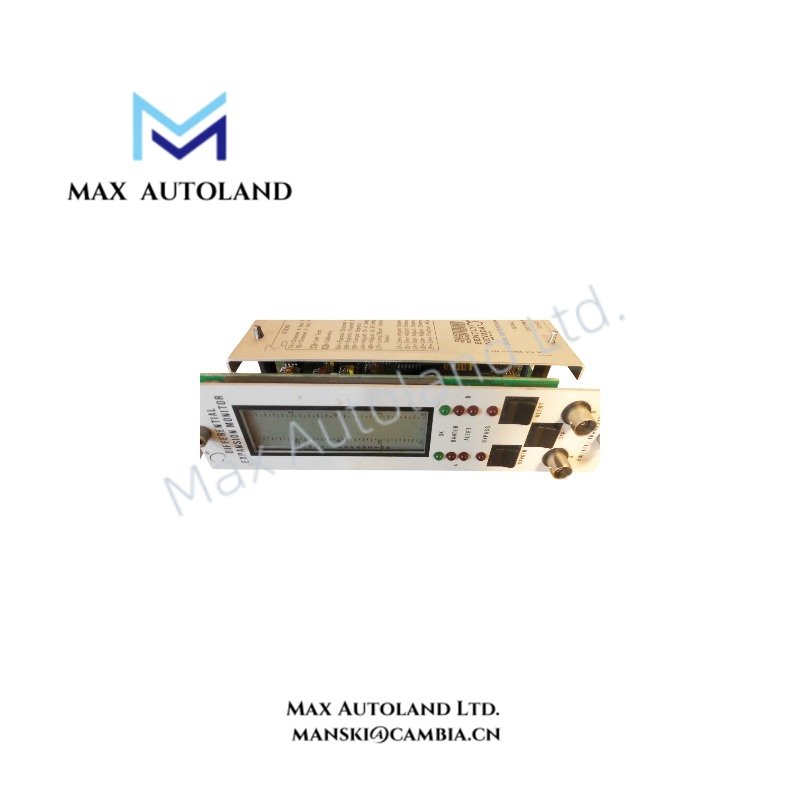
The Bently Nevada 3300/45-02-02-03-00, also cataloged as the 3300/45 Dual Differential Expansion Monitor, operates as a dedicated hardware component for axial position measurement within the Bently Nevada 3300 System. It processes eddy-current probe signals to monitor rotor-to-casing thermal expansion movement.
Hardware Specifications
| Parameter | Specification |
|---|---|
| Model | 3300/45-02-02-03-00 |
| Brand | Bently Nevada |
| Product Type | Dual Differential Expansion Monitor |
| System Platform | Bently Nevada 3300 System Rack |
| Origin | USA |
| Weight | Approx. 0.91 kg |
| Dimensions | 1-slot 3300 System module format |
| Operating Temp | 0 deg C to +65 deg C |
| Storage Temp | -40 deg C to +85 deg C |
| Relative Humidity | Up to 95%, non-condensing |
| Power Consumption | 24 VDC system supply input, module-dependent consumption |
| Channels | 2 continuous differential expansion measurement channels |
| Transducer Input | 3300 XL / 7200 Series 8 mm or 11 mm proximity transducer input |
| Input Impedance | 10 kOhm |
| Transducer Supply Voltage | -24 VDC current-limited supply per channel |
| Accuracy | Typical +/-0.33% of full-scale at +25 deg C, maximum +/-1.0% of full-scale |
| Scale Factor | Jumper selectable 20 mV/mil or 10 mV/mil |
| Buffered Output Impedance | 100 Ohm short-circuit protected |
| Recorder Output | +4 to +20 mA, 0 to -10 VDC, or +1 to +5 VDC |
| Current Output Load | 0 to 600 Ohm |
| Relay Configuration | Quad epoxy-sealed relays with Alert and Danger contacts |
| Relay Contact Rating | 5 A at 120/240 VAC or 5 A at 28 VDC |
| Rack Occupancy | 1 slot |
Eddy-Current Probe Signal Processing and Rotor Dynamics
The 3300/45 module uses Bently Nevada proximity measurement technology to convert axial shaft movement into differential expansion data. It applies eddy-current probe scaling through selectable transducer sensitivity values of 10 mV/mil or 20 mV/mil. Therefore, the monitor maintains measurement compatibility with 3300 XL and 7200 Series proximity transducers.
The module supports turbine supervisory instrumentation functions by evaluating rotor-to-casing axial displacement during thermal transitions. In addition, the system processes continuous position signals to identify abnormal expansion conditions before mechanical interference occurs.
The probe interface supports gap voltage validation based on standard Bently Nevada proximity measurement practices. A nominal -10 VDC gap voltage target provides a reference condition for proper probe installation and signal evaluation.
The dual-channel architecture allows independent differential expansion monitoring. Furthermore, Channel B can be disabled when the application requires single-channel operation.
Frequently Asked Questions
Q: Which proximity transducers can connect to the 3300/45-02-02-03-00 module?
A: The module accepts Bently Nevada 3300 XL and 7200 Series 8 mm or 11 mm eddy-current proximity transducer signals.
Q: Does the module provide relay outputs for machine protection logic?
A: Yes. The C03 option provides four sealed relays with individual Alert and Danger contacts for two monitoring channels.
Q: What output signals are available for external recording systems?
A: The module provides selectable recorder outputs including +4 to +20 mA, 0 to -10 VDC, and +1 to +5 VDC.
Field Installation Guidelines
- Install the module in a compatible Bently Nevada 3300 System Rack slot and verify rack power availability before insertion.
- Connect proximity probe wiring using shielded instrumentation cable and maintain separation from high-current power conductors.
- Ground cable shields according to site grounding practice to reduce electromagnetic interference.
- Verify probe polarity, signal continuity, and gap voltage before placing the channel into service.
- Confirm the selected scale factor matches the installed proximity transducer sensitivity.
- Check Alert and Danger relay configuration before connecting external protection circuits.
- Perform functional verification after installation by applying controlled shaft position simulation or approved commissioning procedures.








Reviews
There are no reviews yet.