


Overview
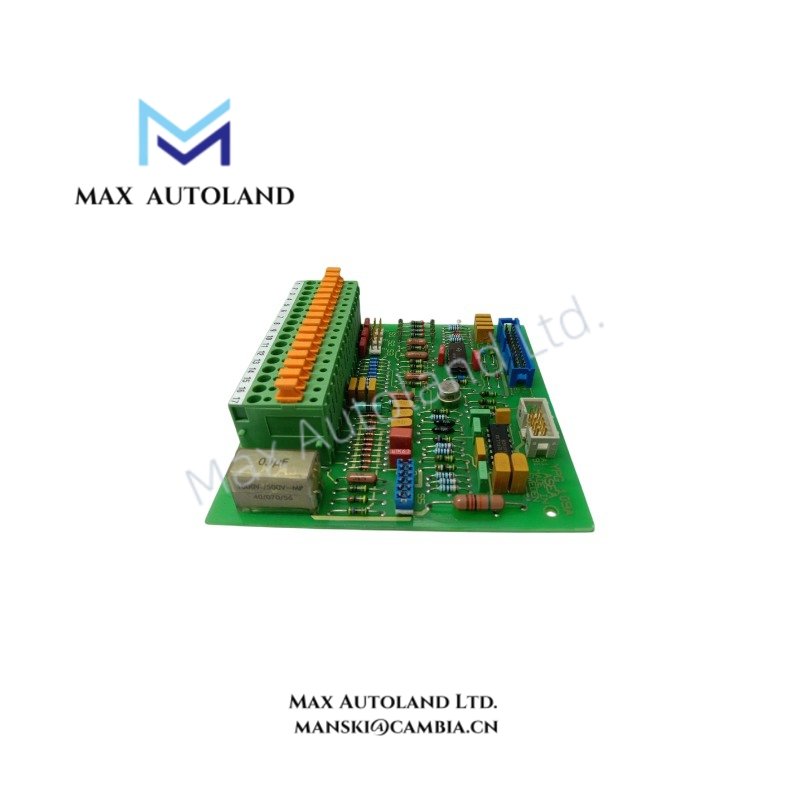
The ABB YPG109A YT204001-CE, also cataloged as the YT204001-CE analog input module, operates as a dedicated hardware component for analog signal acquisition within PLC and distributed control I/O backplane architectures. Configured for current and voltage signal conditioning in modular control racks, the ABB YPG109A YT204001-CE (YT204001-CE Analog Input Module) provides direct electrical interfacing to system-level acquisition buses.
Suffix Breakdown & Model Matrix
No validated manufacturer-declared suffix segmentation is available for YPG109A YT204001-CE. The model is treated as a single ordering and service unit without published functional sub-identifier decomposition.
Hardware Specifications
| Parameter | Specification |
|---|---|
| Model / Brand | ABB YPG109A YT204001-CE |
| Origin | Sweden |
| Weight | 0.1 kg |
| Dimensions | 14.8 x 7.5 x 1.2 cm |
| Operating Temp | -10 degC to +50 degC |
| Humidity | 5-95% RH non-condensing |
| Power Consumption | Not specified (backplane powered module dependent) |
| Core Function | Analog signal acquisition module |
Backplane Bus Communication and Firmware Compatibility Layer
The ABB analog input module class implements deterministic I/O exchange through rack-based backplane communication channels, where scan-cycle timing is governed by controller-side cyclic scheduling rather than module-level execution autonomy. Signal digitization and transfer occur through synchronized slot addressing on the system I/O bus.
Firmware handling is dependent on host controller compatibility layers, with firmware flash operations typically executed via centralized engineering workstation tools. Backplane density scaling influences channel refresh latency, particularly under mixed I/O load conditions where analog acquisition shares bus bandwidth with discrete signal modules. Deterministic behavior is maintained through cyclic poll scheduling rather than event-driven interrupt handling.
Frequently Asked Questions
Q: Does the module support hot-swap during live backplane operation?
A: Hot-swap capability is dependent on the host rack architecture. Electrical isolation design typically requires system-level slot de-energization prior to insertion or removal.
Q: What is the expected backplane current load behavior?
A: Backplane consumption is defined by rack power distribution design. The module does not expose standalone current draw specification and relies on chassis power segmentation.
Q: Can firmware be independently upgraded at module level?
A: Firmware management is generally handled at controller or engineering station level rather than via standalone module flash interfaces.
Field Installation Guidelines
The module shall be installed in a grounded industrial control rack with verified backplane continuity. Ensure insertion alignment with keyed slot guides to avoid connector pin stress. Shielded signal cables must maintain continuous grounding at a single reference point to prevent ground loop formation.
Signal routing shall be separated from high-voltage switching conductors to reduce electromagnetic coupling. Maintain minimum bend radius consistent with standard industrial control wiring practice. All termination points shall be torque-verified according to terminal block mechanical ratings specified by the rack manufacturer.
ABB Top Products
Customers Also Viewed
Contact: Manski Wong +86 18030205725 manski@cambia.cn




Reviews
There are no reviews yet.