




Overview
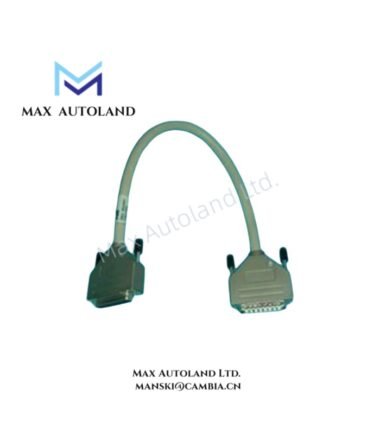
Configured for ModuleBus extension within S800 I/O engineering architectures, the ABB 3BSC950089R2, also cataloged as the TK801V006 ModuleBus Extension Cable, provides direct physical/electrical execution.
Hardware Specifications
| Parameter | Specification |
|---|---|
| Model | TK801V006 |
| Article Number | 3BSC950089R2 |
| Brand | ABB |
| Mechanics | S800 |
| Cable Type | Shielded ModuleBus Extension |
| Length | 0.6 m |
| Connector Type | D-sub 25 (Male/Female) |
| Data Rate Support | Up to 10 Mbps |
| Origin | SWEDEN |
| Weight | 0.3 kg |
| Estimated Shipping Size | 17.8 x 2.5 x 17.8 cm |
| Operating Temperature | -20 to +70 deg C |
| Storage Temperature | -40 to +85 deg C |
| Power Consumption | Passive (Derived from cluster communications interface) |
Backplane Bus Communication Velocity and System Scaling
The TK801V006 cable establishes deterministic electrical synchronization across distributed S800 I/O structures. It sustains backplane bus communication velocity and transmission fidelity up to 10 Mbps without inducing signal degradation across extended DIN-rail layouts. When coupled with TB805/TB845 or TB806/TB846 cluster modems, the cable maintains the essential propagation delay thresholds required for rigid deterministic networks. This enables I/O density scaling across segmented, multi-tier physical profiles while keeping firmware flash compatibility and cycle execution times uniform across all connected I/O modules on the same electrical ModuleBus segment.
Frequently Asked Questions
Q: What is the maximum number of TK801V006 cables that can be linked sequentially?
A: The TK801V006 is engineered to connect specific ModuleBus clusters via TB805/TB845 and TB806/TB846 modems. Cascading multiple extension cables directly in series without proper bus termination or optical modem isolation is prohibited, as it alters the electrical impedance and exceeds the timing budgets calibrated for the 10 Mbps backplane bus communication velocity.
Q: Can this cable be disconnected or replaced while the S800 I/O cluster is energized?
A: No. Disconnecting the TK801V006 under power interrupts the electrical ModuleBus backplane communication, breaking the circuit for downstream I/O units. This causes immediate module communication faults and safety trips within the controller firmware. The associated I/O cluster must be de-energized prior to cable manipulation.
Field Installation Guidelines
- Routing and Bend Radius Restrictions: Maintain a strict minimum bending radius to prevent structural degradation of the internal conductors and the overall braided shield. Avoid routing the cable adjacent to high-voltage, high-current AC lines or variable frequency drive (VFD) output lines to mitigate electromagnetic interference.
- Shield Grounding and Interconnection: Ensure that the D-sub 25 male and female connectors are firmly seated and locked via their integral retention hardware. The integrated cable shield relies on continuous metal-to-metal contact through the connector shells to the DIN-rail chassis ground via the corresponding optical/electrical modems.
- Environmental Conditioning: Verify that ambient operational thresholds do not exceed the certified -20 to +70 deg C envelope. Ensure the routing path is clear of sharp metallic edges or mechanical pinch points within the enclosure layout.
ABB Top Products
Customers Also Viewed
Contact: Manski Wong +86 18030205725 manski@cambia.cn





Reviews
There are no reviews yet.