



Overview
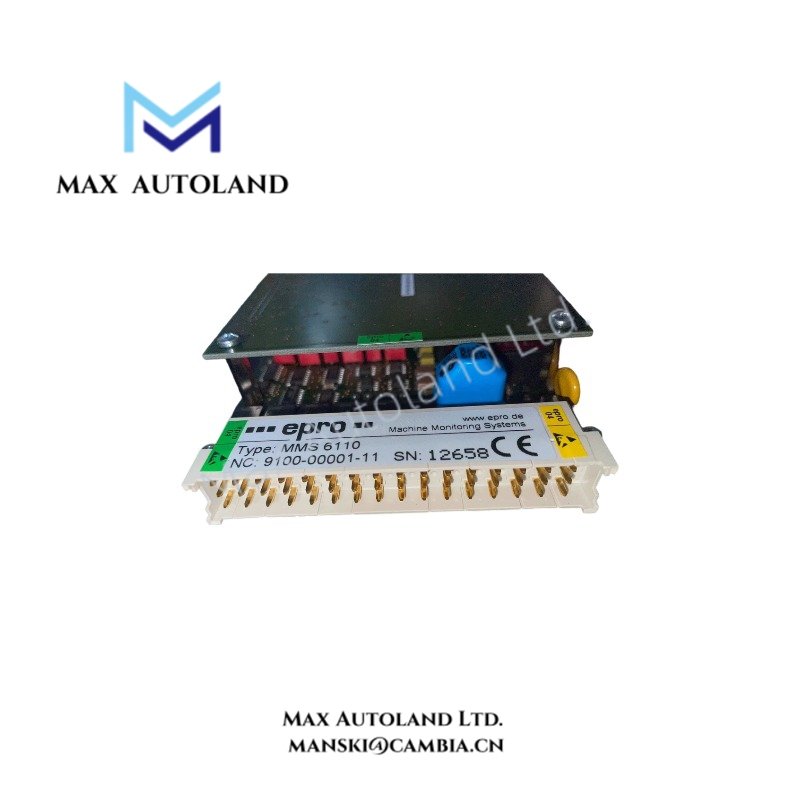
Configured for shaft absolute vibration calculation in the MMS 6000 machinery monitoring system, the Emerson EPRO MMS6140 (MMS6140 Shaft Absolute Vibration Monitor) processes two sensor channels for relative shaft and bearing or casing vibration signals.
Hardware Specifications
| Parameter | Specification |
|---|---|
| Model | MMS6140 |
| Brand | Emerson / EPRO |
| Product Type | Shaft Absolute Vibration Monitor / Dual-Channel Vibration Monitoring Module |
| Number of Channels | 2 independent sensor inputs |
| Channel 1 Input | Eddy-current displacement sensor; -1 to -24 V input range |
| Channel 1 Frequency Range | 0.1 Hz to 16 kHz |
| Channel 2 Input | Seismic or piezoelectric sensor; -5 to +15 V input range |
| Channel 2 Frequency Range | 5/10 Hz to 1000/1600 Hz |
| Channel 1 Sensor Supply | -26.7 V nominal; short-circuit and open-circuit proof; typically 20 mA |
| Channel 2 Sensor Supply | 0 to 8 mA, programmable in 40 uA steps |
| High-Pass Filter | 2nd order Butterworth, adjustable |
| Low-Pass Filter | 5th order Butterworth, adjustable |
| Analog Outputs | 0/4 to 20 mA, proportional to characteristic values |
| Dynamic Voltage Outputs | 0 to 20 Vpp |
| GAP Voltage Output | 0 to 10 VDC |
| Alarm Outputs | Potential-free optocoupler outputs |
| Alarm Output Rating | Maximum 48 VDC, 100 mA |
| Communication Interface | RS232 |
| Front Panel | Status LEDs and SMB sockets for raw signal access |
| System Integration | MMS 6000 series machinery monitoring system |
Channel Signal Processing and Bearing Motion Compensation
The MMS6140 processes two vibration measurement channels to determine shaft absolute vibration. Channel 1 accepts an eddy-current displacement sensor signal, while Channel 2 accepts a seismic or piezoelectric sensor signal.
The module combines the relative shaft vibration signal with the bearing or casing vibration signal. It then applies the configured signal processing and phase compensation to derive the corresponding absolute shaft vibration value.
In addition, adjustable high-pass and low-pass filters define the measurement bandwidth. The module provides proportional 0/4 to 20 mA outputs and dynamic voltage signals for external monitoring equipment.
The alarm section provides separate pre-alarm and main-alarm functions through potential-free optocoupler outputs. Front-panel LEDs indicate channel status and alarm states. Furthermore, the RS232 interface supports parameter configuration and measurement-data retrieval.
Frequently Asked Questions
Q: How many measurement channels does the MMS6140 provide?
A: The MMS6140 provides two independent sensor inputs. Channel 1 accepts an eddy-current displacement sensor, while Channel 2 accepts a seismic or piezoelectric sensor.
Q: What communication interface does the MMS6140 use?
A: The supplied data specifies an RS232 interface for parameter configuration and data retrieval.
Q: What signal outputs are available?
A: The module provides 0/4 to 20 mA analog outputs, dynamic voltage outputs up to 20 Vpp, GAP voltage outputs from 0 to 10 VDC, and potential-free optocoupler alarm outputs.
Field Installation Guidelines
Install the MMS6140 in the designated MMS 6000 rack or card-cage position and follow the applicable system wiring documentation.
Connect the eddy-current displacement sensor to Channel 1 and the seismic or piezoelectric sensor to Channel 2 according to the approved wiring configuration. Keep sensor wiring separated from high-current switching conductors and other strong electromagnetic noise sources.
Use appropriate cable shielding and terminate shields according to the site grounding scheme. Avoid creating unintended ground loops between the monitoring rack, sensor cables, and connected control equipment.
Before commissioning, verify sensor supply polarity, input voltage ranges, signal continuity, and alarm wiring. Then confirm the configured filter characteristics and measurement scaling through the RS232 configuration interface.
Finally, check the raw sensor signals through the available SMB front sockets and verify the measured vibration values against the installed sensor configuration before placing the protection channel into service.


Reviews
There are no reviews yet.