Loop Technology Advances Aerospace Industrial Automation
Loop Technology, a UK-based industrial automation specialist, is advancing aerospace manufacturing with its FibreLINE production platform. The system combines the FANUC M-2000 industrial robot with advanced automation technologies. Together, these technologies help manufacturers produce large composite aircraft structures with greater efficiency and precision.
As aircraft production demand grows, manufacturers must increase output without compromising product quality. Moreover, aerospace components often require tight dimensional tolerances and complex manufacturing processes. Therefore, flexible factory automation has become increasingly important for next-generation aircraft programmes.
FibreLINE Supports Large-Scale Composite Manufacturing
Founded in 1998, Loop Technology has developed automation solutions for demanding industrial applications. Its experience includes robotics, machine vision, motion control and composite manufacturing. The company developed FibreLINE in response to challenges identified through composite wing programmes and collaborative aerospace research.
FibreLINE targets the production requirements of large composite aerostructures. It integrates industrial robotics with measurement and control technologies. As a result, manufacturers can automate complex operations while improving production flexibility and resource utilisation.
Aerospace Automation Requires Precision and High Payload Capacity
Aerospace composite manufacturing presents several technical challenges. Systems must position large components accurately while managing heavy tooling and sensitive materials. According to the supplied project description, some applications require positional accuracy within approximately ±1 mm.
Conventional gantry systems can also create constraints around factory layout, expansion and investment. However, articulated industrial robots offer an alternative for large-scale manufacturing tasks. Their flexible movement and high payload capacity can support different operations within a shared production environment.
FANUC M-2000 Robot Combines Payload Capacity with Precision
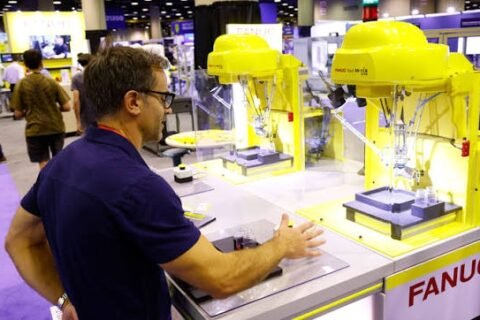
The FANUC M-2000 series provides the high payload capacity needed to handle large aerospace manufacturing tools and components. Its articulated design also supports complex movements across substantial working areas. These characteristics make it suitable for demanding industrial automation applications.
Loop Technology combines the robot with machine vision, photogrammetry and integrated motion control. These technologies help measure component positions and guide robot movements. Consequently, FibreLINE can achieve accuracy of approximately 1 mm across large components, according to the supplied project information.
Actual performance depends on the application, calibration, measurement methods and operating conditions. Manufacturers should therefore validate accuracy against their specific process requirements before production deployment.
FibreLINE Targets Higher Aerospace Production Rates
Aircraft manufacturers continue to explore ways to increase output for future single-aisle aircraft programmes. The supplied report identifies potential production targets of 80 to 100 aircraft per month. Meeting such demand requires efficient production processes, careful resource planning and consistent quality control.
Traditional composite manufacturing may require multiple machines and substantial factory space. In comparison, FibreLINE aims to consolidate selected manufacturing operations within an integrated robotic platform. According to the supplied information, one system can deliver output equivalent to five to ten conventional manufacturing machines.
This comparison depends on the processes involved, cycle times and production configurations. Nevertheless, the approach could help manufacturers improve throughput while reducing equipment duplication. It may also simplify production planning and make better use of available factory space.
Integrated Control Systems Improve Manufacturing Flexibility
Successful aerospace automation requires more than a high-payload robot. Manufacturers must coordinate robot movements, inspection systems, tooling and production workflows. Integrated control systems help manage these elements and maintain consistent process execution.
Machine vision and photogrammetry provide measurement data for positioning and inspection tasks. Meanwhile, motion control coordinates robot trajectories and process movements. Together, these technologies can support repeatable operations and help manufacturers respond to changes in component design or production demand.
PLC-based control systems may also support equipment sequencing, safety interlocks and communication with surrounding production machinery. However, the actual control architecture depends on the FibreLINE installation and its configured equipment. The available project description does not identify specific PLC or DCS models.
Robotics Supports the Future of Aerospace Factory Automation
The Loop Technology and FANUC collaboration highlights the role of industrial robotics in large-scale composite manufacturing. By combining high payload capacity with measurement and motion control technologies, FibreLINE addresses several challenges associated with aerospace production.
Moreover, scalable robotic systems can give manufacturers additional options when planning new production lines. Potential benefits include improved equipment utilisation, reduced factory footprint and increased manufacturing capacity. However, each installation requires a detailed assessment of cycle times, process accuracy and investment costs.
As aerospace production requirements evolve, industrial automation will remain an important part of manufacturing strategy. Solutions such as FibreLINE demonstrate how robotics can support more flexible composite production. They also illustrate the value of integrating mechanical systems, measurement technologies and control engineering into a coordinated manufacturing process.