Data Center Environmental Monitoring: How Temperature and Humidity Control Protect Industrial Uptime
Case Study: Environmental Monitoring as the Silent Guardian of Data Center Uptime
Environmental Monitoring Has Become Critical for Data Center Reliability
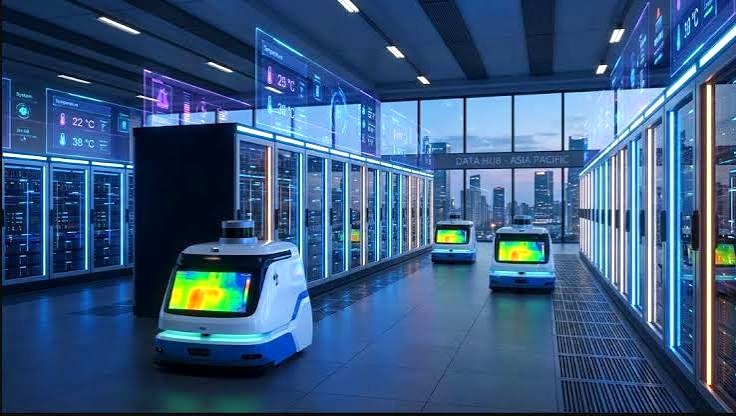
Modern data centers power artificial intelligence, cloud services, financial platforms, and enterprise applications.These facilities host mission-critical servers, storage hardware, and networking systems that must operate continuously.Therefore, even a brief disruption can trigger financial losses, compliance exposure, and reputational damage.Many organizations prioritize power redundancy and cybersecurity. However, environmental monitoring plays an equally important role in protecting uptime.For this reason, leading operators increasingly integrate temperature and humidity monitoring into broader industrial automation and infrastructure strategies.Temperature Control Protects Critical IT Equipment from Hidden Risks
Servers generate large amounts of heat during normal operation.Without sufficient cooling, temperatures can rise beyond safe operating limits.Consequently, hardware may throttle performance, malfunction, or shut down unexpectedly.Even short overheating events can corrupt data or shorten equipment lifespan.This challenge resembles thermal management issues found in factory automation, PLC cabinets, DCS rooms, and industrial control systems.In both environments, stable operating conditions directly influence system reliability.Humidity Management Reduces Corrosion and Electrostatic Damage
Humidity control presents another critical challenge for high-availability facilities.When humidity levels rise excessively, condensation can form on electronic assemblies.As a result, operators may face corrosion, electrical shorts, or component failure.Conversely, extremely dry environments increase electrostatic discharge risk.Static discharge can damage sensitive circuit boards, processors, and communication equipment.Therefore, precise humidity control supports both equipment protection and operational continuity.Energy Efficiency Depends on Intelligent Environmental Control Systems
Many operators attempt to avoid overheating through aggressive cooling strategies.However, excessive cooling increases energy consumption and operating costs.A more sustainable approach relies on precise measurement and adaptive environmental management.This strategy increasingly depends on control systems, SCADA platforms, and industrial automation architectures.Real-time monitoring enables HVAC systems to maintain stable environmental conditions without unnecessary energy use.Consequently, facilities can improve both efficiency and operational resilience.Industry Standards Define Safe Environmental Operating Ranges
Industry organizations such as ASHRAE provide recommended environmental guidelines for data center operations.Most facilities target:- Temperature: 18°C–27°C (64°F–80°F)
- Relative Humidity: 40%–60% RH
Sensor Placement Determines Environmental Monitoring Accuracy
Accurate environmental monitoring begins with effective sensor deployment.Poor placement often creates misleading measurements and delayed responses.Therefore, engineers position monitoring devices at critical airflow and thermal locations.Common installation points include:- Rack inlets and outlets
- Cold aisles and hot aisles
- Raised floor air plenums
- Ceiling return ducts
- UPS and battery rooms
Data Centers Benefit from Multiple Monitoring Architectures
Modern facilities rarely depend on a single monitoring method.Instead, operators combine several environmental monitoring models.Typical approaches include:- Spot monitoring: fixed point measurements
- Zone monitoring: multi-area environmental analysis
- Mobile monitoring: temporary diagnostic assessment
DCIM Integration Strengthens Industrial Automation Performance
Environmental sensors generate greater value when operators connect them to Data Center Infrastructure Management (DCIM) platforms.DCIM software uses real-time data to optimize cooling, energy consumption, and facility performance.Therefore, sensor interoperability becomes essential.Many facilities prefer transmitters that support open industrial protocols and standard outputs.Common interfaces include:- 4–20mA analog signals
- HART communication
- Modbus connectivity
Real-Time Environmental Monitoring Delivers Measurable Operational Benefits
Continuous monitoring creates clear operational advantages.Facilities that track temperature and humidity in real time can respond faster to environmental deviations.Key benefits include:- Reduced downtime risk
- Longer equipment lifespan
- Improved HVAC efficiency
- Stronger SLA and compliance support
- Better operational visibility
Moore Industries HTZ Supports Continuous Temperature and Humidity Monitoring
Some facilities deploy dedicated industrial transmitters for long-term environmental control.One example involves the Moore Industries HTZ Humidity and Temperature Transmitter.The compact, loop-powered device measures both temperature and humidity with strong accuracy and repeatability.Originally developed for semiconductor cleanroom applications, the HTZ also suits data centers that demand uninterrupted performance.Its programming simplicity, industrial durability, and installation flexibility support mission-critical environments.Case Study: Large-Scale Data Center Deploys Dense Environmental Monitoring Network
A large data center project required continuous environmental management for high-density server operations.The design team needed to maintain stable temperature and humidity conditions across multiple operational zones.Therefore, engineers installed monitoring points throughout:- Cold aisles
- Hot aisles
- Areas above server racks
- Areas below server racks
- HVAC supply and return ducts
Challenge: Precision Environmental Control Leaves No Margin for Error
The project team faced strict humidity management requirements.Operators needed to maintain relative humidity between 40% and 60%.Humidity below 40% increased electrostatic discharge risk.Humidity above 60% increased condensation exposure.Because the facility required uninterrupted operation, the monitoring system needed high accuracy, strong scalability, and dependable long-term performance.Furthermore, engineers required a deployment model that supported dense sensor coverage.Solution: Industrial-Grade HTZ Transmitters Enable Reliable Monitoring
The project team selected the Moore Industries HTZ transmitter platform.The device offered several operational advantages:- Stable humidity and temperature measurement
- 4–20mA output with HART communication
- Rugged industrial construction
- Low maintenance requirements
- Long-term operational reliability
Results: Continuous Environmental Data Supports 24/7 Data Center Uptime
The monitoring deployment produced measurable operational improvements.The data center maintained humidity within recommended operating ranges.In addition, the facility reduced risks related to electrostatic discharge and condensation-driven equipment damage.Dense monitoring coverage also supported:- Lower downtime exposure
- Fewer maintenance interventions
- Continuous HVAC optimization
- Stronger operational redundancy
Industry Perspective: Environmental Monitoring Acts as the Silent Guardian of Digital Infrastructure
Environmental monitoring rarely receives the same attention as power systems or cybersecurity.However, temperature and humidity control directly influence uptime, efficiency, and asset longevity.As data centers continue scaling for AI, cloud computing, and digital services, operators will need tighter environmental visibility.This trend creates new opportunities for industrial automation, PLC, DCS, SCADA, and intelligent control systems technologies.From an engineering perspective, environmental monitoring no longer represents a secondary utility function.Instead, it has become a foundational pillar of resilient digital infrastructure.Application Scenario: Integrating Environmental Monitoring into Automated Data Center Operations
Consider a hyperscale data center expanding server density to support AI workloads.Traditional cooling practices may struggle with thermal variability and energy costs.By integrating industrial-grade transmitters with DCIM, PLC, SCADA, or control systems, operators can achieve:- Real-time environmental intelligence
- Adaptive HVAC optimization
- Faster anomaly detection
- Improved energy performance
- Higher infrastructure uptime
- Scalable facility automation
Siemens Xcelerator Helps ADMARES Transform Sustainable Housing Through Digital Twin and Industrial Automation
ADMARES Industrializes Sustainable Housing Design and Manufacturing With Siemens Xcelerator
Digital Manufacturing Brings Industrial Automation to Housing Construction
Siemens and ADMARES are redefining residential construction through digital twin technology, industrial automation, and advanced manufacturing.ADMARES, founded in 2016, applies manufacturing principles to housing production. Instead of relying on traditional construction methods, the company treats homes as standardized, digitalized products.This strategy addresses two major global challenges: affordable housing shortages and skilled labor constraints.As a result, the construction sector increasingly resembles modern factory automation environments.Siemens Xcelerator Enables a Product-Based Housing Model
ADMARES uses the Siemens Xcelerator open business platform to design, manufacture, and operate sustainable homes.The platform combines software, automation technologies, and digital engineering tools into a unified development ecosystem.According to ADMARES CEO Mikael Hedberg, Siemens technology helps shift housing from labor-intensive construction toward industrialized production.This transformation matters because many regions face severe shortages of qualified construction workers.Moreover, productized housing models can improve scalability, cost control, and production consistency.Digital Twin Technology Optimizes Housing Design and Manufacturing
At the center of the project lies Siemens’ comprehensive digital twin framework.ADMARES deploys Siemens Designcenter, Teamcenter, and Simcenter software to create, validate, and optimize modular housing designs.The digital twin does more than represent the final building.It also captures manufacturing data, process behavior, and production workflows.For engineers familiar with PLC, DCS, and industrial control systems, this approach mirrors digital engineering practices used across automotive, aerospace, and industrial automation sectors.Therefore, digital twins continue expanding far beyond traditional manufacturing applications.Advanced Factory Automation Accelerates Home Production
ADMARES supports its housing model with a digital-first, automated greenfield smart factory.The production environment integrates Siemens Opcenter Manufacturing Execution System (MES) software with industrial automation hardware.This architecture supports a takt time of 22.5 minutes per building unit.The company reports that it can produce a fully completed 1,400-square-foot home in roughly 45 minutes.Such production rates highlight how factory automation principles can reshape conservative industries like construction.In practical terms, automated workflows reduce manual variability and improve operational repeatability.Sustainable Construction Benefits from Automation and Process Optimization
Sustainability remains a core element of the ADMARES strategy.The company aims to cut residential construction carbon emissions by up to 75%.In addition, it targets approximately 80% less material waste compared with traditional building methods.These targets align with wider industrial trends toward resource efficiency and low-carbon manufacturing.Industrial automation often plays a critical role in achieving these outcomes.By improving process precision, manufacturers can reduce scrap rates, optimize material usage, and lower energy consumption.The same principles increasingly apply to modular housing production.Smart Homes Combine Connectivity with Real-Time Monitoring
The homes produced through the ADMARES platform include integrated building software for continuous monitoring.Users can access real-time data related to:- Energy consumption
- Water usage
- Indoor air quality
- Smart building performance
Siemens Demonstrates the Business Value of Open Industrial Platforms
Siemens views the ADMARES collaboration as an example of technology-driven business model innovation.According to Siemens Digital Industries sustainability leadership, the project shows how digitalization, automation, and advanced manufacturing can reinvent established industries.This point deserves attention.Construction historically adopted automation more slowly than automotive or electronics manufacturing.However, growing pressure around affordability, labor shortages, and sustainability may accelerate change.Open platforms such as Siemens Xcelerator could help lower integration barriers and speed industry adoption.Industrialized Housing Reflects a Broader Automation Trend
The ADMARES project reflects a broader evolution across industrial sectors.Companies increasingly combine industrial automation, MES software, digital twins, PLC integration, and smart factory technologies to improve productivity and sustainability.Housing now joins a growing list of industries adopting manufacturing-style operating models.This shift may influence how engineers, system integrators, and automation vendors approach future building projects.For B2B readers, the case illustrates how automation expertise can create value beyond traditional factory environments.Application Scenario: Digital Twin and Automation in Modular Housing Production
Consider a modular housing manufacturer planning rapid production expansion.Traditional workflows may involve fragmented design tools, manual planning, and limited production visibility.A Siemens-style digital ecosystem can connect engineering, simulation, manufacturing execution, and automation control into a single workflow.Potential operational advantages include:- Faster design validation
- Improved production planning
- Reduced material waste
- Higher manufacturing consistency
- Better lifecycle traceability
- Scalable smart factory operations
Industry Perspective: Why Construction May Become the Next Automation Frontier
Construction stands at a turning point.Rising demand, environmental regulations, and labor shortages increasingly challenge traditional delivery models.Industrialized housing offers a practical alternative.By combining digital twins, control systems, factory automation, and software-defined manufacturing, companies can create faster, cleaner, and more scalable production models.The Siemens–ADMARES collaboration demonstrates how automation technology can move beyond factories and begin reshaping the future of housing.Aras Strengthens Industrial Automation and PLM Strategy with Appointment of New CEO
Aras Appoints Leon Lauritsen as CEO to Lead Next Phase of Growth
PLM Leadership Transition in Industrial Automation Software Market
Aras Corporation announced the appointment of Leon Lauritsen as its new Chief Executive Officer in September 2025. He replaces Roque Martin, who led the company through strong growth and SaaS transformation.This leadership change comes at a critical time. Industrial automation companies increasingly rely on PLM, digital thread platforms, and integrated data systems. Therefore, executive strategy plays a key role in shaping future competitiveness.CEO Background and Experience in PLM and ERP Systems
Leon Lauritsen brings nearly 30 years of experience in product lifecycle management and enterprise systems. Before becoming CEO, he led global sales and EMEA operations at Aras.Earlier in his career, he worked as an ERP consultant and software programmer. Moreover, he held leadership roles at Minerva before its acquisition by Aras in 2022. As a result, he understands both technical architecture and enterprise deployment challenges in control systems and factory automation environments.Strategic Vision for Digital Thread and AI-Driven PLM
Lauritsen aims to expand Aras into AI-enabled PLM platforms. He emphasizes the use of product data, digital thread technology, and intelligent workflows.In modern industrial automation, companies depend on connected systems across PLC, DCS, and supply chain networks. Therefore, Aras positions its platform to unify engineering, manufacturing, and service data. In addition, AI integration improves decision-making speed and reduces lifecycle costs.Industry Shift Toward SaaS and Flexible PLM Platforms
Under Roque Martin’s leadership, Aras transitioned strongly into SaaS-based PLM delivery. This shift aligns with broader trends in factory automation software.Many manufacturers now prefer scalable cloud-based control systems. However, legacy on-premise PLM systems still dominate in heavy industries. Therefore, hybrid architectures are becoming common in industrial automation projects.From practical experience in digital manufacturing projects, SaaS PLM reduces deployment time significantly. Moreover, it improves collaboration between engineering teams across global sites.Competitive Positioning in Industrial Automation Software Market
Aras competes with large PLM vendors in aerospace, automotive, and industrial manufacturing sectors. Its advantage lies in flexibility and modular architecture.Unlike rigid legacy platforms, Aras supports customization without heavy coding. Therefore, engineers can integrate it with PLC-based systems and enterprise DCS environments more easily. In addition, this reduces integration cost in complex automation projects.Market Trends Driving PLM and Digital Thread Adoption
Industrial automation continues to evolve toward data-driven operations. Manufacturers now focus on lifecycle transparency and predictive engineering.Moreover, digital thread platforms connect design, production, and maintenance data. As a result, companies improve traceability and reduce downtime in factory automation systems.In my view, the combination of PLM and AI will become a standard requirement rather than a competitive advantage. Therefore, vendors that fail to adapt may lose relevance in control systems markets.Author Commentary on Industry Direction
This leadership change reflects a broader transformation in industrial software. Companies no longer compete only on features. Instead, they compete on ecosystem integration and intelligence.However, successful adoption still depends on implementation experience. Many manufacturers struggle to connect PLM systems with real-world PLC and DCS infrastructure. Therefore, vendors like Aras must focus on usability and integration support, not only platform capability.Application Scenarios in Industrial Automation and PLM Systems
Aras PLM and digital thread solutions can support multiple industrial use cases:- Automotive manufacturing with complex multi-tier supply chains
- Aerospace engineering requiring strict lifecycle traceability
- Industrial equipment design integrated with PLC-based control systems
- Smart factory environments using real-time production data analytics
- Maintenance optimization for large-scale DCS-controlled plants
Conclusion: Leadership Change Supports AI-Driven PLM Evolution
The appointment of Leon Lauritsen marks a strategic step for Aras. The company strengthens its focus on AI, SaaS PLM, and digital thread innovation.As industrial automation advances, integration between product lifecycle systems and factory control environments will become essential. Therefore, Aras positions itself to support the next generation of intelligent manufacturing platforms.ISA Launches Advanced OT Cybersecurity Training for Industrial Automation at 2025 Automation Summit
ISA Announces Two Exclusive OT Cybersecurity Training Courses at the 2025 Automation Summit & Expo
Enhancing Industrial Cybersecurity Knowledge
The International Society of Automation (ISA) will offer two specialized OT cybersecurity courses at the 2025 Automation Summit & Expo in Lake Buena Vista, Florida. These classes provide industrial automation professionals with practical skills to secure PLC, DCS, and control systems against cyber threats.Course 1: Securing Control Systems with ISA/IEC 62443
The first course, Using the ISA/IEC 62443 Standards to Secure Your Control Systems (IC32), teaches participants how to implement internationally recognized cybersecurity standards. Engineers learn risk assessment, security management, and best practices for applying robust protections across industrial control systems.Course 2: Assessing Cybersecurity of IACS Systems
The second course, Assessing the Cybersecurity of New and Existing IACS Systems (IC33), focuses on evaluating industrial automation and control systems (IACS). Attendees learn to identify vulnerabilities, conduct thorough security assessments, and implement mitigation strategies for both new and legacy systems.Hands-On Training and Practical Insights
Both courses offer immersive, expert-led instruction over October 8–9. Participants gain real-world skills to assess risk, strengthen control systems, and enhance factory automation resilience. These classes complement attendees’ knowledge of PLCs, DCS, and overall industrial automation cybersecurity strategies.Flexible Registration Options
Attendees can register for these training courses independently of conference registration. Training fees are separate, and participants select courses via the “Training Registration Options” drop-down menu in the event registration form. This flexibility allows professionals to focus specifically on skills most relevant to their roles.About the Automation Summit & Expo
ISA’s Automation Summit & Expo (ASE) is a premier event showcasing industrial automation innovation. Taking place at Disney’s Coronado Springs Resort from October 5–7, ASE offers sessions on PLC, DCS, and factory automation trends. Attendees explore how automation transforms industries while networking with peers and industry experts.Why Cybersecurity Training Matters for Industrial Automation
Industrial control systems increasingly face cyber threats that can disrupt factory automation and compromise critical infrastructure. By completing these ISA OT cybersecurity courses, engineers and managers can proactively secure control systems, reduce operational risk, and enhance reliability across industrial operations.Application Scenarios for Industrial Automation
- Factory Automation Security: Protect PLCs and DCS from unauthorized access and malware.
- Control System Risk Assessment: Evaluate new and existing IACS systems to identify vulnerabilities.
- Operational Continuity: Integrate best practices from ISA/IEC 62443 to maintain secure, resilient production.
Transforming Pressure Safety Valves into Smart Assets for Industrial Automation
Turning Pressure Safety Valves Into Smart Devices to Enhance Process Safety
Understanding PSV Risks in Factory Automation
Pressure safety valves (PSVs) protect pipelines and vessels by releasing fluid at preset pressures. However, many incidents reveal that operators often miss critical performance indicators, such as set-pressure drift, blowdown, and chatter. Without continuous monitoring, PSVs remain passive devices, increasing the risk of unrecognized failures in industrial automation and control systems.Limitations of Traditional In-Service PSV Testing
Conventional in-service testing confirms valve movement or bench calibration at a single moment. However, it cannot capture real process dynamics, including transients, fluid effects, or backpressure. Scheduled inspections also often overlook gradual deterioration between tests. For high-altitude or hard-to-access PSVs, removal and lab testing is costly, labor-intensive, and may even damage the valve.Enhancing PSVs with Continuous Monitoring
To overcome testing limitations, modern pressure monitoring integrates upstream and downstream sensors with PLC, SCADA, or DCS systems. By analyzing differential pressure (ΔP = P1 – P2), engineers can detect partial lifts, abnormal reseat behavior, and valve opening characteristics. This approach provides real-time diagnostics without physically accessing the PSV.Measuring Blowdown and Set-Pressure Drift
Continuous pressure measurement enables accurate calculation of blowdown—the difference between actual set and reseat pressures. Monitoring upstream and downstream pressures also detects set-pressure drift caused by corrosion, spring fatigue, or improper sizing. Early identification of drift prevents unplanned releases and enhances process safety in factory automation.Detecting PSV Chatter in Industrial Systems
Chatter occurs when a PSV rapidly opens and closes, rather than stabilizing pressure as designed. This damages valve seats and internal components, compromising safety. Trending P1 and P2 in control systems identifies chatter patterns, allowing proactive maintenance. High-frequency pressure data from accurate transmitters is essential for detecting these fast transient events.Benefits of Smart PSV Monitoring
Integrating PSV diagnostics into industrial automation systems provides multiple benefits. Engineers gain insight into valve performance, enabling predictive maintenance and minimizing downtime. Continuous monitoring reduces reliance on human intervention, prevents catastrophic incidents, and improves operational reliability. Moreover, it supports compliance with IEC 61511 by keeping diagnostics separate from safety-critical shutdown logic.Design Considerations for PSV Diagnostics
Implementing PSV monitoring requires careful sensor selection to withstand high pressures, temperatures, and transient loads. Differential pressure transmitters offer a cost-effective solution for typical relief events, while high-speed sensors are necessary for root cause analysis of chatter or critical safety applications. Control systems must also have fast-sampling analog input modules to capture transient signals accurately.Final Insights: PSV Monitoring as a Critical Safety Layer
Global incident reports highlight the consequences of unmonitored PSVs. By transforming PSVs into smart, diagnosable devices, industrial automation facilities can enhance safety, protect assets, and reduce environmental impact. Continuous monitoring complements existing safety instrumented systems and strengthens overall process control reliability.Application Scenarios in Industrial Automation
- Chemical Plants: Use upstream and downstream pressure monitoring to prevent overpressure releases.
- Oil & Gas Facilities: Integrate PSV diagnostics with DCS for predictive maintenance and downtime reduction.
- Factory Automation: Combine PLC-based monitoring with flow and pressure analysis to optimize control system safety.
Digital Twin Consortium Expands Industrial Automation Capabilities with Eight Innovative Testbeds
Digital Twin Consortium Adds Eight New Testbeds
DTC Launches New Digital Twin Testbeds to Accelerate Industrial Automation
The Digital Twin Consortium (DTC) has added eight new member-led testbeds, bringing its Digital Twin Testbed Program to a total of 16. These testbeds allow industrial automation professionals to model, simulate, integrate, verify, and deploy digital twin solutions more effectively. By providing early-stage access to testbed development, DTC enables members to optimize factory automation, PLC integration, and control systems performance.TWINSENSE: Enhancing Industrial Asset Monitoring with AI
The TWINSENSE testbed demonstrates AI-driven virtual sensing for real-time monitoring of industrial assets. By combining virtual and physical data, it calibrates novelty detection systems and improves predictive maintenance accuracy by up to 40%. This testbed showcases how digital twins can overcome limitations of inaccessible or high-cost measurement points in modern control systems.AEGIS: Personalized Learning Solutions through Multi-Agent Systems
AEGIS applies digital twins to education, using multi-agent AI systems to analyze survey data from high-risk students. The testbed simulates interventions that improve engagement and reduce dropout rates. This approach demonstrates that digital twin technology can support data-driven decision-making beyond industrial automation, extending to human performance and operational efficiency in educational environments.FAB: Rapid Disaster Manufacturing for Resilient Communities
The Factory-in-a-Box (FAB) testbed offers a modular, mobile manufacturing unit enabled by digital twins. It produces critical energy components in disaster-struck areas, reducing logistical costs and downtime. Moreover, the digital twin interface allows remote coordination, demonstrating the potential of resilient, micro-scale manufacturing in emergency scenarios. This approach can inspire similar automation strategies in industrial and humanitarian operations.Q-Smart: Securing Smart Homes with Quantum-Safe Digital Twins
Q-Smart integrates digital twins, multi-agent AI, and quantum-safe protocols to create self-learning, energy-efficient smart home systems. The testbed manages HVAC, ventilation, and energy consumption, reducing energy use by up to 25%. Industrial automation engineers can draw parallels to factory systems where edge-native processing and predictive AI enhance both security and operational efficiency.TRANSFORM: Dynamic 4D Modeling for Infrastructure and Smart Cities
TRANSFORM converts static 2D data into dynamic 4D geospatial digital twins. Using wireless mesh networks, sensors, and AI, it monitors home conditions and enables predictive energy management. This testbed highlights the broader applicability of digital twins in industrial automation, including utility management, transportation, and smart city infrastructure.SAFESME: Fast Onboarding for SME Manufacturing Equipment
SAFESME focuses on SMEs, enabling rapid commissioning and digital service transformation of injection molding and packaging machines. Digital twins reduce setup time, operator effort, and overall integration cost. For industrial automation professionals, this demonstrates practical strategies for cost-effective PLC and control system upgrades.ENGAGE: Supporting At-Risk Students with Academic Digital Twins
ENGAGE develops digital twins to monitor academic performance, engagement, and behavioral signals. By analyzing previously invisible data, it helps educational institutions intervene early. While primarily an educational application, this testbed illustrates how digital twin frameworks can extend to any data-intensive environment, including complex industrial systems.SYNTHEKID: Optimizing Healthcare Delivery through Digital Twins
SYNTHEKID creates synthetic digital twins of chronic kidney disease pathways to optimize healthcare delivery in Yorkshire, UK. Privacy-preserving simulations allow scenario planning without exposing patient data. Industrial automation professionals can learn from this approach, applying digital twin strategies for sensitive data environments such as process control in regulated industries.Driving Digital Twin Evolution in Industrial Automation
The DTC testbed program leverages its Composability Framework, which includes the Business Maturity Model, Platform Stack Architecture, and Capabilities Periodic Table. This structured approach ensures that members can evaluate generative AI, multi-agent systems, and other advanced technologies while improving factory automation, DCS integration, and overall control system performance.Applications and Solutions
These testbeds provide practical insights for:- Predictive maintenance and AI-driven asset monitoring in manufacturing
- Rapid deployment of modular industrial systems for emergency response
- Energy optimization in smart buildings and industrial facilities
- Cost-effective digital twin integration for SMEs
- Cross-industry applications from healthcare to education
Electromate Announces Fall SPARK Symposiums to Advance Industrial Automation Knowledge
Electromate Announces Fall SPARK Symposiums in Waterloo, Ontario and Montreal, Quebec
Industry-Focused Events in Waterloo and Montreal
Electromate will host its biennial Fall SPARK Symposiums (Showcasing Precision and Robotic Knowledge) this October. These complimentary events target OEMs, machine builders, system integrators, and engineering students. Competitors are not admitted, ensuring focused industry engagement.
The symposiums will feature a tabletop show format accompanied by classroom presentations focusing on robotics and mechatronics. Attendees will have the opportunity to engage with leading manufacturers.
Waterloo Event: Precision and Automation Insights
- Date: Tuesday, October 28, 2025
- Time: 9 a.m. – 3 p.m.
- Location: University of Waterloo, E7 Building, Second Floor Event Space, 200 University Avenue West, Waterloo, Ontario N2L 3G5 Attendees will gain hands-on exposure to advanced motion control and robotics solutions. A continental breakfast and light lunch will be provided, fostering networking opportunities.
Montreal Event: Industrial Automation and Robotics Innovation
- Date: Thursday, October 30, 2025
- Time: 9 a.m. – 3 p.m.
- Location: École de technologie supérieure ÉTS, 1100 Notre-Dame St W, Montreal, Quebec H3C 1K3 The Montreal session focuses on factory automation, PLC integration, and precision machine technologies. Participants can engage directly with Electromate engineers and see demonstrations of control systems in action.
Why Attend: Expert Insights on Robotics and Motion Control
Electromate specializes in high-performance robotics, mechatronics, and motion control for industrial automation. The SPARK Symposiums provide practical knowledge on integrating PLCs, DCS, and smart control systems. Attendees will learn strategies to improve machine performance, reduce downtime, and enhance manufacturing efficiency.Enhancing Industry Knowledge Through Hands-On Experiences
By attending these events, participants experience real-world applications of precision automation. Electromate experts demonstrate advanced robotic systems, discuss integration challenges, and highlight emerging trends in factory automation. Moreover, networking with peers helps attendees share insights on best practices and innovative solutions.Author Insight: Driving Automation Competitiveness
In today’s competitive manufacturing landscape, understanding the integration of control systems and motion technology is critical. Electromate’s SPARK Symposiums bridge theory and practice, enabling engineers and system integrators to implement solutions that improve productivity, optimize operations, and prepare factories for Industry 4.0 challenges.Registration and Participation
The events are free but require registration in advance. Early registration ensures participation and access to all presentations, hands-on demonstrations, and networking sessions.Applications and Solution Scenarios
- Factory Automation: Optimizing production lines with PLCs and smart robotics.
- Precision Manufacturing: Applying motion control to high-accuracy machine tools.
- System Integration: Streamlining DCS and control systems for enhanced operations.
- Education & Skill Development: Engineering students gain real-world experience in industrial automation.
Siemens and TRUMPF Join Forces to Advance Industrial Automation and AI-Ready Factories
Siemens and TRUMPF Accelerate Digital Manufacturing and AI Readiness
Bridging IT and OT for Smarter Factories
Siemens and TRUMPF announced a strategic collaboration to enhance industrial automation and digital manufacturing. By combining Siemens' Xcelerator portfolio with TRUMPF's machine tool and software expertise, the partnership addresses a persistent challenge: connecting IT systems with operational technology (OT) on the factory floor. This integration ensures faster data flow, real-time decision-making, and greater production efficiency.Leveraging AI in Motion Control Applications
The collaboration emphasizes AI readiness for manufacturing operations. Siemens and TRUMPF are developing open and interoperable IT interfaces that support intelligent motion control systems. As a result, factories can implement predictive maintenance, automated process optimization, and data-driven decision-making more seamlessly than ever.Enhancing Factory Flexibility Through Integrated Systems
Modern manufacturing increasingly depends on software-driven solutions. Siemens and TRUMPF focus on combining hardware and software into fully integrated systems. This approach reduces complexity, accelerates innovation cycles, and allows factories to adapt quickly to changing production demands, enhancing flexibility and operational agility.Modular Architectures for Scalable Automation
The partnership introduces modular system architectures and standardized interfaces, enabling smooth connectivity between shop floor equipment and enterprise-level systems. This approach reduces engineering costs, supports scalable factory expansions, and ensures future-proof automation. Open, modular solutions empower manufacturers to adopt AI tools without disrupting existing processes.TRUMPF’s Role in Smart Factory Leadership
TRUMPF strengthens its position as a leading provider of smart manufacturing solutions, particularly in the sheet metal industry. Through this collaboration, TRUMPF machines, robots, and AI-enabled part recognition tools can communicate more effectively with Siemens digital platforms. This creates new opportunities for productivity, quality assurance, and digital process optimization.Fostering Innovation Through Ecosystem Collaboration
Continuous collaboration between Siemens and TRUMPF development teams demonstrates the importance of a vibrant industrial ecosystem. By sharing expertise and aligning on standards, both companies accelerate the deployment of industrial automation solutions, enabling manufacturers to stay competitive in an AI-driven era.Industry Insight: Why This Matters
Connecting IT and OT systems is a cornerstone of modern industrial automation. Manufacturers that implement AI-ready, modular solutions can reduce downtime, enhance predictive maintenance, and improve product quality. Siemens and TRUMPF’s approach sets a benchmark for integrating software, PLCs, DCS, and control systems in high-volume production environments.Applications and Solution Scenarios
- Factory Automation: Streamlined communication between machines, robots, and PLCs for automated production lines.
- Predictive Maintenance: AI-driven analytics to anticipate equipment failures and optimize maintenance schedules.
- Process Optimization: Real-time monitoring and control of production parameters to improve throughput and reduce waste.
- Digital Twin Integration: Simulating production processes to test improvements before implementing on the shop floor.
Ethernet Powers AI-Driven Industrial Automation at ECOC 2025
Ethernet and AI Converge in Ethernet Alliance's ECOC 2025 Demo
Ethernet Alliance Demonstrates Next-Generation Connectivity
The Ethernet Alliance will showcase its latest innovations at ECOC 2025 in Copenhagen from September 29 to October 1, 2025. The live multivendor demonstration highlights optical and copper connections ranging from 100G to 800G, including Linear Pluggable Optics (LPO). This demonstration emphasizes Ethernet’s critical role in enabling industrial automation and AI workloads.AI and Ethernet Converge for Industrial Control Systems
Ethernet provides the bandwidth, low latency, and flexible provisioning needed to train complex AI models. By ensuring interoperability across diverse systems, it removes bottlenecks that can slow AI applications in industrial automation, PLCs, DCS, and factory control networks. As a result, engineers can deploy AI tools and predictive analytics more efficiently.Industry Leaders Collaborate on Interoperability
Participating companies include Alphawave Semi, Amphenol Corporation, Cisco Systems, Formerica OptoElectronics, Huawei, Keysight Technologies, MultiLane, Synopsys, TE Connectivity, Teledyne LeCroy, and VeEX. Their joint efforts demonstrate Ethernet’s ecosystem strength, showing how collaborative standards enable seamless integration in industrial and AI networks.AlphaCHIP1600 Enhances Plug-and-Play Networking
Alphawave Semi’s AlphaCHIP1600 I/O chiplet exemplifies ecosystem-first design, supporting plug-and-play Ethernet interoperability. From high-density data-center switches to edge AI accelerators, the chiplet accelerates time-to-market and future-proofs deployments. This solution underlines the importance of modular, high-performance networking in modern industrial automation.Ethernet’s Role in Scalable Industrial Automation
Peter Jones, chair of the Ethernet Alliance, notes, “Ethernet links AI clusters and industrial control networks, ensuring fast, reliable, and scalable connections.” By integrating Ethernet into PLCs, SCADA systems, and DCS networks, manufacturers can improve real-time monitoring, predictive maintenance, and factory automation efficiency.Future-Proof Networking for AI Applications
David J. Rodgers of EXFO emphasizes that interoperability enables Ethernet to connect the world’s most powerful compute engines. For industrial automation, this means faster insights, responsive control systems, and networks ready to evolve alongside AI-driven factory technologies.Applications in Industrial Automation
- High-Speed AI in Factories: Use Ethernet to link AI accelerators for predictive analytics.
- PLC and DCS Integration: Ensure seamless data flow across control systems for real-time decision-making.
- Edge-to-Cloud Connectivity: Connect edge devices to cloud platforms with low latency and secure bandwidth.
- Plug-and-Play Upgrades: Deploy modular networking components like AlphaCHIP1600 for flexible factory automation.