Automation Addresses Manufacturing Workforce Challenges
At IMTS 2026, igus presented motion and automation technologies for modern manufacturing.
The company focused on faster deployment, practical integration, and lower automation costs.
These priorities reflect persistent workforce constraints across the manufacturing sector. (igus® Press)
For manufacturers, industrial automation can reduce repetitive manual work.
It can also help skilled workers focus on higher-value production activities.
Therefore, automation increasingly supports both productivity and workforce planning.
RBTX Simplifies Factory Automation Integration
igus highlighted its RBTX marketplace as part of its automation strategy.
The platform brings together igus products and technologies from automation partners.
Users can therefore configure automation solutions around specific production requirements.
The marketplace also provides transparent pricing and multiple technology options.
This approach can simplify early-stage system evaluation for manufacturers.
Moreover, it reduces the need to source every automation component independently.
From an engineering perspective, this ecosystem model has practical advantages.
A complete automation cell often requires motion systems, robots, controls, sensors, and vision.
Integrating these elements can otherwise create additional engineering and commissioning work.
Open Automation Ecosystems Support Flexible Applications
igus does not position itself as a complete software automation provider.
Instead, the company focuses on motion hardware and related automation technologies.
It works with partners that provide robotic arms, vision systems, and application-specific equipment.
This strategy reflects a broader shift toward modular factory automation.
Manufacturers can select different components according to application requirements.
As a result, automation systems can support different machine architectures and production processes.
This model also fits applications where manufacturers need gradual automation expansion.
A company may initially automate one machine or repetitive process.
It can then expand the system after validating productivity and integration results.
Motion Components Remain Important in Industrial Automation
The igus IMTS 2026 exhibit emphasized the physical movement layer of automation.
Its showcase included motion plastics, energy supply systems, robotics, and linear motion technologies. (igus® Press)
These components support applications involving continuous mechanical movement.
Examples include cable management, linear positioning, machine tending, and robotic motion.
The company also demonstrated the E4Q e-chain system for industrial cable management.
Its drylin and drylin E technologies target grease-free linear motion and motorized automation. (igus® Press)
For factory engineers, these components matter because automation performance depends on the entire motion chain.
A robot alone cannot solve problems caused by poor cable routing or mechanical constraints.
Therefore, mechanical design remains closely connected to PLC and control-system performance.
PLC and Control Systems Still Define the Automation Architecture
Robotic equipment usually operates as part of a wider control architecture.
PLCs can coordinate machine sequences, sensors, actuators, safety devices, and production signals.
Industrial networks then connect these devices with supervisory and manufacturing systems.
In larger facilities, DCS and SCADA platforms may manage broader process operations.
However, discrete manufacturing often relies heavily on PLC-based control systems.
The correct architecture depends on machine complexity, process requirements, and data integration needs.
This is why automation projects should evaluate the complete control loop.
Engineers need to consider sensors, controllers, communication, actuators, and mechanical response together.
Automation Models Are Becoming More Flexible
The IMTS 2026 automation landscape also showed increasing interest in flexible deployment models.
These include financing, rental, subscription, and automation-as-a-service approaches.
Such models can reduce the initial capital requirement for some manufacturers.
IMTS reported automation solutions across its technology sectors.
Its 2026 Automation Sector includes robotics, integration, motion control, vision, software, and digital technologies. (国际制造技术展览会)
For smaller manufacturers, deployment flexibility can influence automation adoption.
However, the commercial model should match the production process and expected utilization.
A low initial cost does not automatically guarantee a suitable technical solution.
Application Scenario: CNC Machine Tending
CNC machine tending provides a practical example of this automation approach.
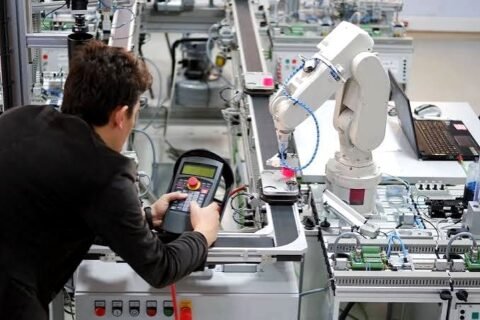
A robotic arm can load raw parts and remove finished components.
A PLC or robot controller can coordinate the sequence with the CNC machine.
Additional sensors can verify part presence and machine status.
Vision systems can support part identification when product variation increases.
Meanwhile, appropriate grippers and motion components determine mechanical handling performance.
This type of application can also support unattended production.
However, engineers must address tooling, chip management, coolant, safety, and fault recovery.
Automation works best when the complete production process supports continuous operation.
Industry View: Hardware Integration Remains a Core Requirement
The direction shown at IMTS 2026 suggests that automation adoption is moving toward modular solutions.
Manufacturers increasingly need practical systems rather than isolated automation components.
From an engineering perspective, open ecosystems can shorten technology selection and integration cycles.
However, interoperability, safety, communication protocols, and maintenance still require careful validation.
The growing role of AI and digital manufacturing does not remove this requirement.
Instead, digital technologies add another layer above the physical automation infrastructure.
The machine still needs sensors, controllers, drives, motion systems, and mechanical components to execute commands.
Therefore, successful factory automation requires coordination between hardware and software.
igus’ IMTS 2026 approach highlights the continuing importance of that physical automation foundation. (igus® Press)
Conclusion: Practical Automation for Modern Manufacturing
igus used IMTS 2026 to emphasize motion as a foundation of industrial automation.
Its RBTX marketplace adds an ecosystem approach to automation system development.
Meanwhile, its motion technologies address the mechanical requirements behind automated equipment.
For manufacturers, the practical lesson is straightforward.
Automation projects should begin with a clearly defined production problem.
Engineers can then select the appropriate PLC, robot, motion, sensing, and control technologies.
As labor constraints continue, modular factory automation may become increasingly relevant.
However, technical suitability should remain the primary consideration for every deployment.