Asia Leads the Global Industrial Automation Market
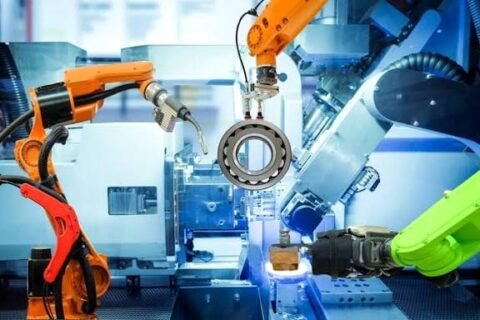
Asia has become a major center for global industrial automation. Japan remains a leading force in industrial robot manufacturing worldwide.
In 2024, Japanese manufacturers accounted for about 38% of global robot production. Asia also led robot deployment during the same year.
Nearly three-quarters of new factory robot installations went to Asian facilities. China represented the largest share of those installations.
Moreover, Asian companies lead many industrial automation segments. These segments include robotics, sensors, motion control, industrial computing, and factory software.
AI now adds another growth driver. It is increasing demand for automated equipment that can deliver higher precision and faster production.
Labor Shortages Accelerate Factory Automation
Demographic change strongly influences automation investment across Asia. China, Japan, and South Korea all face ageing populations.
Their working-age populations are also shrinking. As a result, manufacturers face tighter labor markets and higher employment costs.
Governments have therefore increased support for automation. South Korea, for example, promotes robotics through financial incentives and technical programs.
China has also placed factory automation at the center of its manufacturing strategy. The country aims to double robot density between 2025 and 2030.
National and regional programs support domestic automation manufacturers. These policies have helped local suppliers expand their market presence.
In 2025, Chinese robot manufacturers reportedly outsold overseas suppliers in China. This marked an important shift in the world’s largest industrial robot market.
Precision Manufacturing Creates New Automation Demand
Labor shortages are not the only reason companies invest in industrial automation. Manufacturing precision has become equally important.
Modern production lines must maintain consistent quality at increasingly smaller tolerances. Machine learning, sensors, and digital control systems can improve this consistency.
Semiconductor manufacturing provides a clear example. Some production processes require tolerances of only a few nanometres.
Such requirements increase demand for high-precision motion systems, machine vision, sensors, PLC systems, and industrial control platforms.
Therefore, factory automation now supports both labor productivity and manufacturing accuracy.
Machine Vision Provides the Factory’s Eyes
Industrial automation can be viewed through several functional layers. The first layer operates directly around the workstation.
Machine vision and industrial sensors act as the factory’s sensing layer. They inspect components, identify defects, and verify assembly conditions.
Japanese company Keyence has built a strong position in this market. Its products support machine vision, measurement, sensing, and inspection applications.
These technologies help manufacturers detect defects without slowing production. They also provide machine-level data for higher-level control systems.
As a result, machine vision increasingly connects physical production with digital manufacturing systems.
Motion Control Forms the Factory’s Mechanical Layer
Robotic joints and motion components provide the mechanical movement required by automated production.
Servo motors convert electrical control commands into precise mechanical motion. Servo drives and inverters then regulate motor speed, torque, and position.
Chinese automation manufacturer Inovance has established a strong position in this market. The company holds around 37% of China’s domestic AC servo market.
These systems work closely with PLCs and other control systems. Together, they coordinate positioning, speed control, and machine sequencing.
Humanoid robotics creates another opportunity for motion-control suppliers. Joint actuators combine motors, reducers, screws, and sensors into compact mechanical assemblies.
Sanhua Intelligent Controls has expanded its precision engineering capabilities into linear and rotary actuator technologies.
Industrial Computing Becomes the Factory Brain
Factories also require a computing layer that can process production data. Industrial computers increasingly provide this function.
Taiwanese company Advantech is a major supplier of industrial computing and IoT technologies. Its systems connect machines, sensors, networks, and cloud platforms.
This architecture allows manufacturers to collect operating data across production lines. It can also support predictive maintenance and production analytics.
Industrial PCs can work alongside PLCs, DCS platforms, SCADA systems, and other control systems. Therefore, industrial computing increasingly connects machine-level automation with enterprise data.
Material Handling Creates the Factory Circulatory System
Automated production also depends on efficient material movement. Components must reach the correct workstation at the correct time.
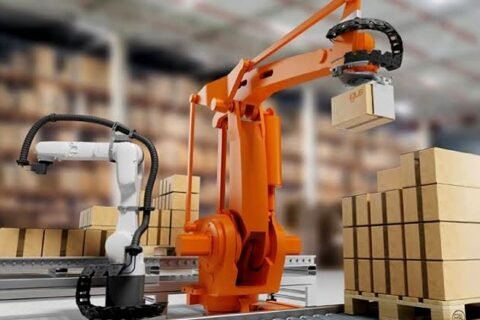
Automated conveyors, guided vehicles, and storage systems perform this function. They create a material-handling layer across the factory.
Japanese company Daifuku is a major supplier in this field. Its automation systems serve semiconductor facilities, warehouses, and distribution centers.
These applications require accurate movement and consistent system operation. In addition, semiconductor production demands particularly controlled material-handling processes.
Control Systems Keep Production Within Limits
The final layer involves real-time process control. Control systems continuously monitor operating conditions and adjust equipment.
Single-loop and multi-loop controllers regulate variables such as temperature and process conditions. Automatic control valves then translate control decisions into physical process changes.
Japanese automation company Azbil operates in this control market. Its technologies support process measurement and automatic regulation.
PLC and DCS platforms perform related control functions at different automation levels. PLCs typically manage machine sequences and discrete operations.
DCS platforms commonly coordinate continuous process operations across larger industrial facilities. Together, these systems form a key part of modern factory automation.
AI Expands the Industrial Automation Opportunity
AI is changing how manufacturers use automation technologies. Its impact extends beyond robotics and individual machines.
First, AI can improve the capabilities of automated equipment. Adaptive systems can interpret changing conditions and respond to unexpected events.
This capability can reduce engineering effort for certain applications. It also supports flexible automation for more varied production tasks.
Collaborative robots provide one example. Cobots can operate alongside workers and perform repetitive or variable tasks.
AI Improves Factory Software and Engineering
AI also affects the software layer of industrial automation. Manufacturers increasingly use AI to support programming and engineering activities.
Inovance has reported that AI-assisted coding can reduce engineering programming time by up to 40%.
Such applications can accelerate PLC programming and equipment configuration. They can also help engineers manage increasingly complex automation projects.
However, engineers still need to validate generated code. Industrial control systems require strict testing before deployment on production equipment.
AI Infrastructure Drives Automation Investment
AI creates another source of demand for factory automation. The rapid expansion of AI infrastructure requires large volumes of precision manufacturing.
Server production requires automated assembly and inspection. High-speed connectors also require accurate manufacturing processes.
Advanced semiconductor packaging creates further demand for precise equipment. Meanwhile, new semiconductor fabs require extensive automation across production and material handling.
Therefore, AI does not only transform software. It also increases demand for the industrial automation hardware needed to build AI infrastructure.
Asia’s Automation Leaders Target High-Value Niches
Asia’s industrial automation strength extends across several specialized markets. These include sensing, robotics, motion control, industrial computing, material handling, and process control.
Companies such as Keyence, Inovance, Sanhua Intelligent Controls, Advantech, Daifuku, and Azbil operate in different parts of this ecosystem.
Their positions reflect a broader trend. Manufacturers increasingly combine physical automation with data, software, and AI.
This convergence creates new opportunities for suppliers with specialized engineering capabilities. It also raises the value of precision components and control technologies.
AI and Industrial Automation Will Develop Together
The next stage of factory automation will likely combine robotics, sensors, PLCs, DCS, industrial networks, and AI software.
AI can help machines interpret production data and adjust operations. Meanwhile, traditional control systems will continue to provide deterministic machine and process control.
Manufacturers therefore need both intelligent analytics and proven control architectures. The two technologies can complement each other rather than replace one another.
Asia has strong positions across both areas. Its large manufacturing base also provides a broad environment for testing and deploying new automation technologies.
Asia Remains a Key Industrial Automation Growth Region
Asia’s leadership in robot production and adoption gives the region a strong position in global factory automation.
Demographic pressure will continue to encourage manufacturers to automate repetitive and precision-intensive work. Government programs may further accelerate domestic automation investment.
At the same time, AI is creating new requirements for manufacturing speed, accuracy, and flexibility.
For industrial automation companies, the opportunity extends beyond robotics alone. PLC, DCS, motion control, machine vision, industrial computing, and control systems all remain important.
The companies that combine these technologies with practical manufacturing needs may capture the next phase of industrial automation growth.