
Overview
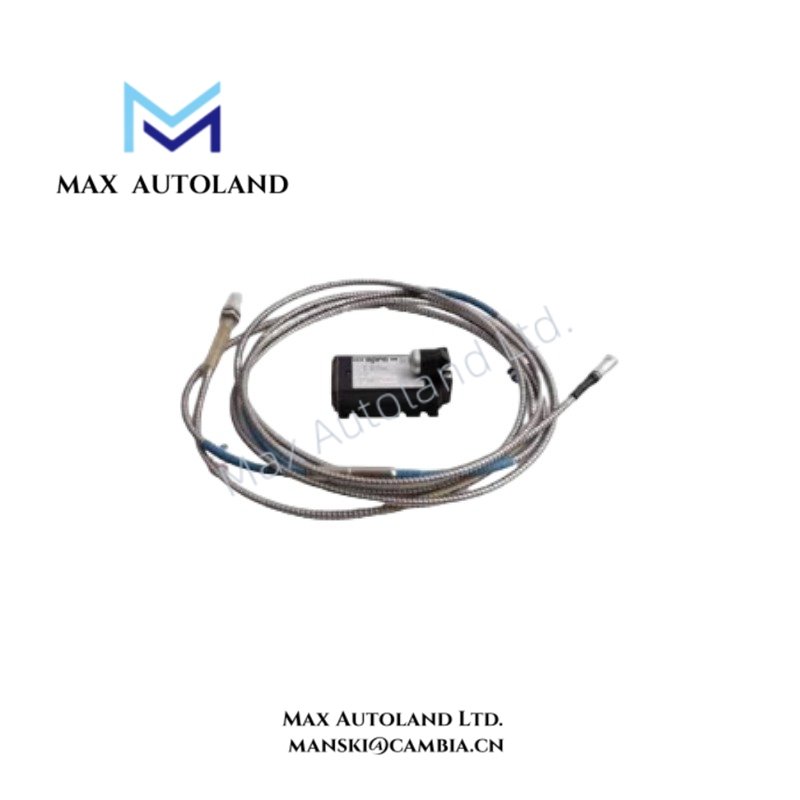
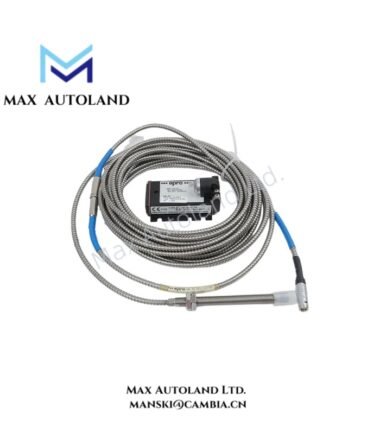
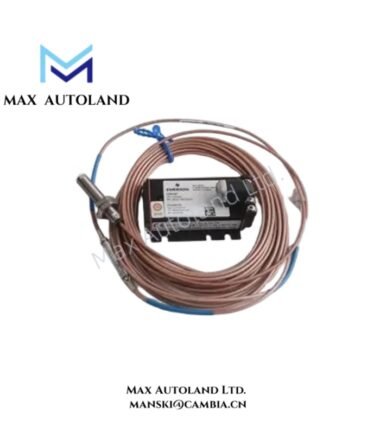
Configured for non-contact displacement measurement in machinery condition monitoring and protection systems, the EPRO PR6423/016-100 (PR6423/016-100 Eddy Current Proximity Sensor) delivers direct physical signal acquisition by detecting electromagnetic induction changes between its tip and a ferromagnetic target.
Hardware Specifications
| Parameter | Specification |
|---|---|
| Model | PR6423/016-100 |
| Brand | EPRO / Emerson |
| Origin | Germany |
| Weight | Approximately 100 g with 1 m cable |
| Dimensions | 8 mm sensor tip diameter |
| Operating Temp | -35 to +180 deg C (sensor), -35 to +150 deg C (cable/connector) |
| Power Consumption | Powered via compatible signal converter |
| Linear Measurement Range | 2 mm (80 mils) |
| Initial Air Gap | 0.5 mm (20 mils) |
| Incremental Scale Factor | 8 V/mm (203.2 mV/mil) ±5% |
| Linearity Deviation | ±0.025 mm (±1 mil) |
| Minimum Shaft Diameter | 25 mm |
| Standard Target Material | 42CrMo4 (AISI/SAE 4140) ferromagnetic steel |
| Protection Rating | IP66 |
Emerson Process Control and Measurement Protocols
Engineers interface the sensor directly with industrial condition monitoring frameworks through dedicated signal converters. Furthermore, internal circuitry supports precise loop calibration because the device maintains a stable gap voltage output matching standard eddy-current probe scaling (-10 VDC nominal center gap). Consequently, operators evaluate dynamic rotor responses, radial shaft vibration, and axial displacement effectively without experiencing signal attenuation or high-frequency distortion across the measurement chain.
Frequently Asked Questions
Q: What is the required initial air gap for the PR6423/016-100 sensor during installation?
A: Technicians must set an initial air gap of 0.5 mm (20 mils) to operate the device within its specified 2 mm linear measurement range.
Q: Can operators connect this sensor directly to a PLC without a signal converter?
A: No, the eddy current proximity sensor requires a compatible signal converter because it must process the high-frequency modulated carrier signal into a proportional DC voltage or current output.
Q: What material does the manufacturer recommend for the target shaft?
A: The manufacturer calibrates the sensor for standard 42CrMo4 (AISI/SAE 4140) ferromagnetic steel targets; therefore, utilizing alternative materials requires recalibration of the scale factor.
Field Installation Guidelines
First, verify that the mechanical mounting threads match the housing specifications, and ensure that technicians respect the minimum shaft diameter of 25 mm. Second, adjust the sensor position carefully to achieve the precise initial air gap of 0.5 mm using a feeler gauge or micrometer before locking the jam nuts securely. Finally, route the PTFE-insulated cable away from high-voltage power lines to prevent electromagnetic interference, and verify the signal converter DC output voltage prior to full system commissioning.


Reviews
There are no reviews yet.