Hexagon Boosts Industrial Automation with OPC UA Metrology
Hexagon Connects Metrology and Industrial Automation Systems
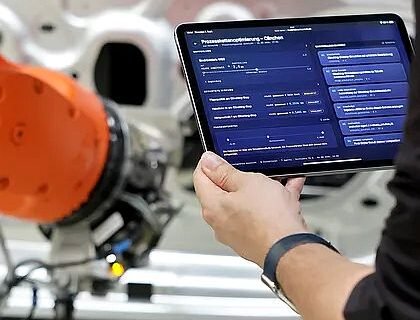
Hexagon Manufacturing Intelligence has expanded its SpatialAnalyzer platform with OPC UA support, creating a stronger connection between precision metrology and industrial automation systems. The update allows measurement software to communicate directly with PLC, robot controllers, and factory automation platforms.
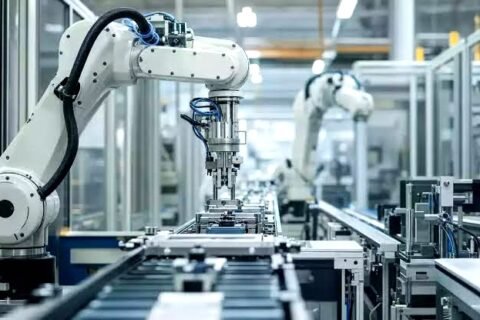
For large-scale manufacturing industries, such as aerospace, energy, and shipbuilding, maintaining accuracy remains a major challenge. Manufacturers increasingly use robots to improve productivity; however, robot positioning accuracy can decrease when production involves large and complex structures.
Therefore, Hexagon’s OPC UA integration helps manufacturers combine high-precision measurement data with automated control systems. This approach supports more accurate robotic operations and improves overall production efficiency.
OPC UA Improves Communication Between PLC and Robotic Control Systems
OPC UA has become a widely adopted industrial communication standard for modern automation environments. It enables secure data exchange between different control systems, including PLC, DCS, SCADA, robots, and manufacturing execution systems.
Hexagon’s latest SpatialAnalyzer release uses OPC UA technology to create a direct communication channel between metrology equipment and automation systems. As a result, production lines can use measurement feedback to adjust robotic processes automatically.
The system includes encryption and authentication functions to protect industrial data transmission. Moreover, Hexagon provides 25 new MP/SDK commands that help developers build customized OPC UA automation workflows.
From an industrial automation perspective, this development represents a shift from traditional offline inspection toward closed-loop manufacturing control. Measurement data no longer remains isolated in quality departments; instead, it becomes part of the factory automation process.
Precision Challenges in Large-Scale Robotic Manufacturing
Large-format manufacturing requires extremely accurate positioning during assembly, drilling, welding, and inspection processes. Industries such as aircraft manufacturing and shipbuilding often work with components that exceed several meters in size.
Although industrial robots provide speed and repeatability, they cannot always achieve the precision required for complex assemblies. Mechanical deformation, thermal changes, and installation errors can affect robot accuracy.
Hexagon addresses these limitations by combining robot automation with advanced metrology solutions. The SpatialAnalyzer platform helps manufacturers monitor part position, verify alignment, and support precision-assisted assembly operations.
Based on practical automation projects, integrating measurement feedback into robot control can significantly reduce manual correction steps. This approach also improves production consistency for high-value components.
SARCA Robot Calibration Technology Enhances Automation Accuracy
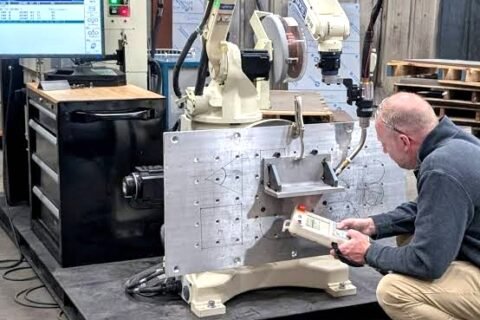
In addition to OPC UA support, Hexagon introduced SARCA, a robot calibration device designed for high-precision industrial applications. The system uses multi-zone and multi-tool calibration methods to improve robot positioning performance.
Before robots enter production, manufacturers can use SARCA to identify and correct accuracy deviations. This preparation helps automation engineers achieve better results in applications that require tight tolerances.
For aerospace and defense manufacturing, robot calibration plays an important role because small positioning errors can create significant assembly problems. Therefore, accurate calibration improves both manufacturing quality and process stability.
Leica Absolute Tracker ATS800 Expands Industrial Metrology Capabilities
Hexagon also increased SpatialAnalyzer compatibility with the Leica Absolute Tracker ATS800 metrology system. The solution supports room scanning, reflector-based laser tracking, and direct feature scanning.
This capability allows manufacturers to select different measurement methods according to production requirements. Moreover, system integrators can incorporate new metrology technologies into customized automation solutions through Hexagon’s System Integrator Programme.
For modern factories, flexible measurement technology supports digital transformation strategies. Manufacturers can collect accurate production data and use it to optimize robotic workflows, quality inspection, and process control.
Industrial Automation Trends: From Robot Automation to Closed-Loop Manufacturing
The integration of metrology and control systems reflects a broader trend in industrial automation. Traditional factories often separated production equipment, quality inspection, and engineering data. However, Industry 4.0 environments increasingly require connected systems.
By combining OPC UA, PLC control, robotic automation, and precision measurement, manufacturers can create more intelligent production processes. These systems support real-time decision-making and reduce dependence on manual inspection.
In my experience working with industrial automation systems, successful automation projects depend not only on hardware performance but also on communication reliability and data integration. OPC UA provides a practical foundation for connecting different automation layers.
Applications of Hexagon Metrology Solutions in Factory Automation
Aerospace Component Manufacturing
Aircraft manufacturers can use SpatialAnalyzer with robotic systems for drilling, assembly alignment, and inspection of large aircraft structures. The solution helps maintain precision while increasing production capacity.
Energy Equipment Production
Large turbines, generators, and industrial machinery require accurate assembly processes. Metrology-assisted automation helps engineers verify component alignment before final installation.
Shipbuilding and Heavy Industry
Shipyards often handle oversized structures where manual measurement creates efficiency limitations. Integrated metrology and robotic automation can improve positioning accuracy during fabrication.
Expert View: Precision Data Becomes a Key Element of Future Automation
The future of industrial automation will depend increasingly on the combination of control systems, robotics, and real-time measurement data. Manufacturers cannot rely only on faster machines; they also need accurate information to control complex processes.
Hexagon’s OPC UA-enabled SpatialAnalyzer demonstrates how metrology can become part of the automation architecture. This development provides a practical pathway for factories that want to improve robotic accuracy, production quality, and digital integration.
As manufacturing moves toward flexible and intelligent production models, technologies that connect measurement data with PLC, DCS, and robotic control systems will continue to gain importance.