Global Robot Demand in Factories Doubles Over 10 Years
Global Industrial Automation and Robot Installation Growth Trends
The latest IFR World Robotics 2025 report confirms strong global expansion in industrial automation.
International Federation of Robotics reported 542,000 industrial robot installations in 2024.
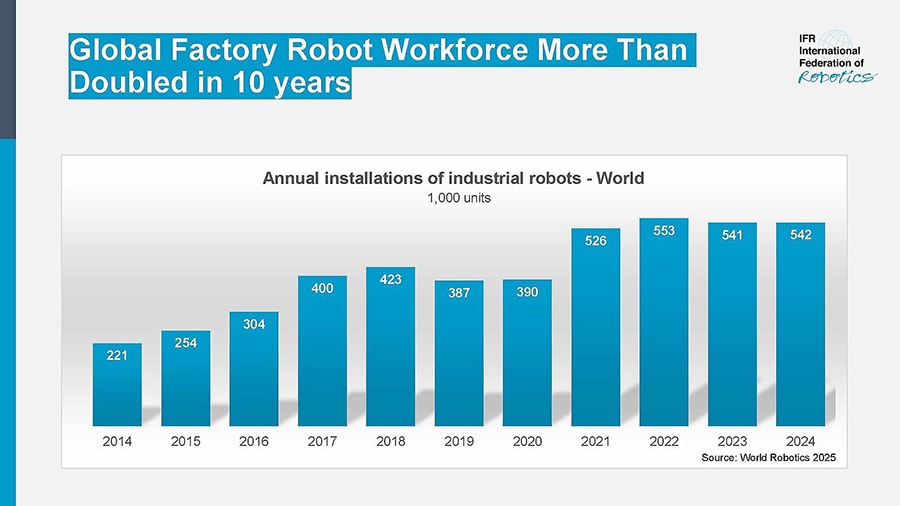
This figure is more than double the level recorded ten years earlier.
Moreover, annual installations stayed above 500,000 units for the fourth consecutive year.
The total operational robot stock reached 4.66 million units worldwide.
Therefore, factory automation continues to expand across global manufacturing sectors.
From an industrial automation perspective, this growth supports wider adoption of PLC and DCS systems.
It also strengthens integration across smart manufacturing and control systems.
Asia Dominates Industrial Automation Robot Deployment
Asia remains the largest region for industrial robot adoption.
It accounts for approximately 74% of global installations in 2024.
China leads the global market with 295,000 new installations.
Moreover, it represents more than half of global robot deployment activity.
China’s domestic manufacturers increased market share to 57%.
As a result, local supply chains now dominate industrial automation expansion.
Japan remains the second-largest market with 44,500 installations.
However, demand shows slight short-term fluctuation due to economic cycles.
South Korea recorded 30,600 installations in 2024.
Meanwhile, India continues strong growth driven by automotive factory automation.
From a control systems perspective, Asia is rapidly scaling PLC-based production lines.
This supports higher efficiency in large-scale manufacturing ecosystems.
European Industrial Automation and Factory Robotics Trends
Europe recorded 85,000 industrial robot installations in 2024.
Although this represents an 8% decline, it remains historically high.
Germany leads the region with nearly 27,000 installations.
Moreover, it accounts for about one-third of Europe’s total demand.
Italy, Spain, and France follow as major automation markets.
However, performance varies due to automotive and manufacturing cycles.
Nearshoring strategies continue to support European factory automation investment.
Therefore, industrial control systems remain a key modernization driver.
From an engineering standpoint, European manufacturers prioritize precision and safety.
This increases demand for advanced DCS and robotics integration.
Industrial Robot Growth in the Americas Manufacturing Sector
The Americas region installed over 50,000 industrial robots in 2024.
However, this reflects a moderate decline compared to the previous year.
United States remains the largest regional market.
It accounts for 68% of total installations in the Americas.
Mexico and Canada follow, driven mainly by automotive manufacturing.
Moreover, investment cycles strongly influence annual installation patterns.
The United States relies heavily on imported robotics systems.
However, system integrators play a critical role in deployment success.
From a factory automation view, integration capability matters more than hardware origin.
Therefore, PLC and control system expertise becomes essential.
Industrial Automation Technology Drivers and Market Outlook
Industrial robot demand continues to grow despite economic uncertainty.
Global GDP growth remains stable between 2.9% and 3.1%.
However, geopolitical risks and supply chain disruption create volatility.
In addition, automation investment cycles differ across regions.
Experts expect 575,000 robot installations in 2025.
Moreover, long-term projections exceed 700,000 units by 2028.
Industrial automation continues to evolve toward AI-driven production systems.
Therefore, robotics integration with PLC and smart control systems becomes standard.
From my perspective, manufacturers increasingly view automation as resilience infrastructure.
It is no longer only a productivity enhancement tool.
Author Insight on Industrial Automation and Robotics Expansion
Industrial robotics adoption reflects a structural transformation in manufacturing.
Factories now prioritize flexibility, data integration, and digital control systems.
Moreover, integration between robotics, PLC, and DCS is becoming tighter.
This improves synchronization across complex production environments.
However, regional inequality in adoption still exists.
Therefore, system integrators play a key role in knowledge transfer.
Overall, industrial automation is entering a mature but expanding phase.
It combines robotics, AI, and advanced control architectures.
Application Cases in Factory Automation Systems
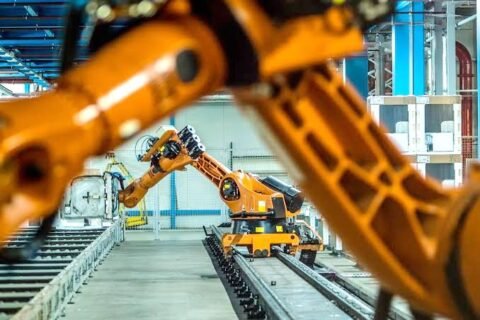
Industrial robots are widely used in automotive assembly lines.
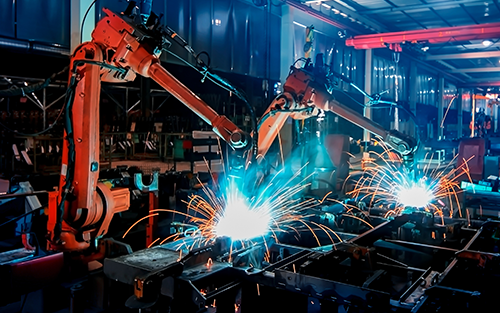
They improve welding, painting, and precision assembly operations.
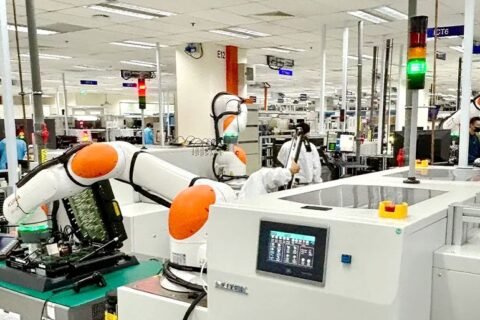
Moreover, electronics manufacturing relies on high-speed robotic handling systems.
This ensures consistent quality in mass production environments.
In logistics and e-commerce, robots optimize packaging and sorting workflows.
Therefore, factory automation reduces operational cost and human workload.
These applications demonstrate the integration of robotics with control systems.
They also highlight the importance of PLC and DCS coordination.