Yokogawa Presents the IA2IA Vision
Yokogawa recently presented its vision for the future of industrial operations at ARC Advisory Group’s Industry Forum in Bengaluru. Dr. Rajeev Joshi, Deputy General Manager, introduced the IA2IA concept, meaning Industrial Automation to Industrial Autonomy.
The presentation explored how industrial companies can introduce AI into existing control environments step by step. Instead of replacing current systems, AI can extend their capabilities.
This approach matters because most industrial sites already operate mature PLC, DCS, and control systems. Therefore, manufacturers need an evolutionary path rather than a complete technology replacement.
Industrial AI Requires Higher Performance Standards
AI already supports many office activities, including content generation, data analysis, and project coordination. However, industrial automation environments demand much stricter performance and validation requirements.
A poor office recommendation may waste time or require revision. In contrast, an incorrect industrial decision can affect production, equipment availability, product quality, and personnel safety.
Therefore, industrial AI must operate within defined technical and operational boundaries. It must also work with established safety systems, control systems, alarms, and operator procedures.
In practical industrial applications, engineers cannot treat AI as an independent decision-making tool. They must integrate it carefully with existing automation architectures.
Industrial Automation Remains the Foundation
Modern industrial automation already provides a strong technical foundation for autonomous operations. PLC systems execute machine sequences, while DCS platforms manage continuous and batch processes.
PID controllers regulate process variables such as pressure, temperature, flow, and level. Meanwhile, Advanced Process Control can optimize more complex operating conditions.
These technologies depend primarily on predefined engineering logic and mathematical models. Operators usually intervene when processes move beyond expected operating conditions.
AI introduces another capability to this architecture. It can analyze larger datasets and identify patterns that conventional control logic may not recognize.
However, AI should complement established automation instead of replacing proven control strategies.
From Fixed Logic to Adaptive Industrial Control
Traditional factory automation depends heavily on predefined instructions. Engineers configure control strategies according to known process requirements and expected operating conditions.
This approach remains effective for stable and predictable applications. However, industrial processes often experience changing feedstock, equipment conditions, production targets, and environmental influences.
Industrial autonomy introduces adaptive capabilities into this environment. AI models can analyze changing conditions and recommend or execute approved responses.
The operating environment must remain bounded and secure. Therefore, engineers still need to define limits for AI-based decisions.
This principle becomes especially important in industries such as oil and gas, chemicals, power generation, and pharmaceuticals.
Understanding the IA2IA Industrial Autonomy Framework
Yokogawa describes the transition through its IA2IA framework, which represents Industrial Automation to Industrial Autonomy.
The framework does not suggest that companies should immediately build fully autonomous plants. Instead, organizations can gradually increase autonomous capabilities as their technology and operational readiness improve.
This gradual approach reflects real industrial conditions. Most facilities operate equipment from different generations and manufacturers.
For example, one site may combine modern DCS technology with older PLC systems, field instruments, historians, and third-party control packages.
Therefore, successful industrial autonomy requires integration rather than replacement.
Stage One: Conventional Industrial Automation
The first stage consists of traditional industrial automation. PLC, DCS, SCADA, and other control systems execute programmed strategies.
Operators monitor process conditions and respond to abnormal situations. Engineers modify control logic when production requirements change.
This structure remains common across global manufacturing industries. It provides predictable control and clear engineering accountability.
Moreover, established systems already support many international engineering and functional safety practices.
Stage Two: AI-Assisted Industrial Operations
The next stage introduces AI as a decision-support technology. AI analyzes operational data and provides recommendations to engineers and operators.
For example, AI can identify abnormal equipment behavior before a conventional alarm reaches its configured threshold.
Predictive maintenance represents a practical application at this stage. Machine learning models can analyze vibration, temperature, pressure, and electrical data.
Operators and maintenance engineers still make the final decisions. Therefore, companies can validate AI recommendations without immediately changing control authority.
From an engineering perspective, this stage offers one of the lowest-risk entry points for industrial AI.
Stage Three: Collaborative Human and AI Control
As confidence increases, AI can take a more active role in operational optimization. However, human operators continue supervising important decisions.
AI may recommend production adjustments, energy optimization strategies, or equipment operating points. Operators can then approve, reject, or modify those recommendations.
This collaborative model can improve consistency across shifts. It can also help less experienced operators access knowledge developed by senior engineers.
However, organizations must carefully manage knowledge transfer and model validation. Historical plant data does not always represent future operating conditions.
Therefore, engineers should continuously monitor AI performance.
Stage Four: Supervised Autonomous Operations
At higher maturity levels, AI can perform selected actions automatically within approved operating limits.
For example, an AI application may optimize energy consumption while remaining inside predefined process constraints.
The control system can continue enforcing interlocks, alarms, and safety limits. Therefore, AI does not replace the fundamental protection architecture.
This distinction remains important for industrial control systems.
AI may optimize operations, but safety instrumented systems must continue performing their independent protective functions where required.
Stage Five: Industrial Autonomy
The highest maturity stage involves increasingly autonomous operations across multiple industrial functions.
Systems can perceive current operating conditions, predict future situations, evaluate available responses, and execute approved actions.
However, complete autonomy does not mean removing people from industrial operations.
Human expertise remains necessary for engineering design, safety management, strategic decisions, and abnormal situations outside validated operating boundaries.
Therefore, industrial autonomy should focus on improving human capability rather than eliminating human responsibility.
AI Must Work with Existing PLC and DCS Systems
One major challenge involves integrating AI with existing industrial automation infrastructure.
Most plants cannot simply replace their PLC or DCS platforms. These systems often support production assets for decades.
Therefore, AI applications need secure connections to historians, industrial networks, asset management systems, and control systems.
Common industrial technologies may include OPC UA, industrial Ethernet, edge computing, and secure data historians.
The architecture must also address cybersecurity and network segmentation. AI applications should never introduce uncontrolled access paths into critical control networks.
This requirement becomes increasingly important as industrial connectivity expands.
Data Quality Determines AI Performance
Industrial AI depends heavily on operational data quality.
Many plants collect large volumes of data. However, incomplete tags, inconsistent timestamps, incorrect engineering units, and poor sensor maintenance can reduce model accuracy.
Therefore, companies should evaluate their data infrastructure before deploying AI.
Engineers should review instrument calibration, historian configuration, communication reliability, and tag consistency.
In my experience, many industrial AI projects face greater challenges with data preparation than with AI algorithms.
A technically sophisticated model cannot compensate for consistently inaccurate process data.
Experience Matters in Industrial AI Deployment
Industrial AI requires more than software expertise. Engineers must understand the physical process behind the data.
For example, a vibration pattern may indicate several possible mechanical conditions. The correct interpretation often requires knowledge of machine design and operating history.
Similarly, process temperature changes may result from feedstock variation, control valve behavior, heat transfer performance, or sensor problems.
Therefore, domain experts must participate throughout AI development and deployment.
The strongest industrial AI projects combine data science with automation engineering, process knowledge, and maintenance experience.
Functional Safety Cannot Become an AI Experiment
Industrial autonomy creates new opportunities, but safety requirements remain unchanged.
Systems that perform safety-related functions must follow applicable engineering practices and standards. Depending on the application, these may include standards such as IEC 61508 and IEC 61511.
AI-based optimization should remain separate from independent safety protection layers where appropriate.
Moreover, engineers must define clear authority boundaries between AI applications and safety systems.
An AI model may recommend an operating adjustment. However, the established protection system must still respond when hazardous conditions occur.
This architecture supports innovation without weakening proven safety principles.
Cybersecurity Becomes Part of Industrial Autonomy
Greater autonomy requires greater connectivity. However, increased connectivity can also expand cybersecurity risks.
Industrial organizations should apply established cybersecurity practices when connecting AI platforms to operational technology environments.
Standards such as the IEC 62443 series provide useful guidance for industrial automation and control system security.
Network segmentation, identity management, access control, logging, and asset monitoring should remain part of the architecture.
Therefore, industrial autonomy projects should include cybersecurity engineers from the earliest design stages.
Practical Applications for Industrial AI
Industrial AI can already support several practical applications without requiring full autonomous control.
Common examples include:
- Predictive maintenance for rotating machinery and electrical equipment
- Energy optimization for industrial processes
- Production quality prediction
- Process anomaly detection
- Operator decision support
- Alarm analysis and rationalization support
- Production scheduling optimization
- Equipment performance monitoring
- Digital twin applications
- Factory automation optimization
These applications allow organizations to gain operational experience before increasing autonomous control levels.
Application Scenario: AI in a Process Plant
Consider a chemical processing plant using a DCS for continuous process control.
The facility collects temperature, pressure, flow, composition, and energy data through field instruments and historians.
An AI application analyzes historical and real-time information. It identifies combinations of operating conditions associated with reduced energy efficiency.
The system first provides recommendations to operators. Engineers compare those recommendations with established operating procedures.
After sufficient validation, the organization may allow automatic optimization within predefined limits.
The DCS continues controlling the process. Meanwhile, independent protection systems maintain their designated safety functions.
This approach demonstrates how industrial AI can evolve alongside existing control systems.
Application Scenario: AI for Factory Automation
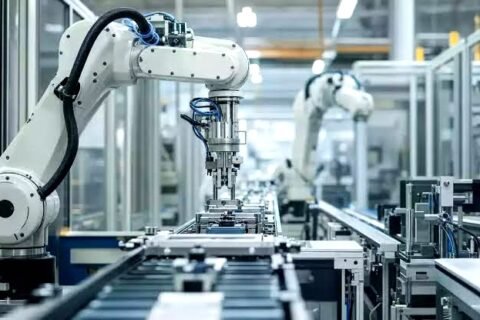
A manufacturing facility may use PLC systems to control conveyors, robots, motors, and production equipment.
AI can analyze production cycle times, equipment status, and quality information.
The system may identify recurring bottlenecks or predict machine failures. Maintenance teams can then schedule inspections before production interruptions occur.
Moreover, AI can support production planning by comparing demand forecasts with equipment capacity.
This approach allows factory automation systems to become more adaptive without replacing established PLC control logic.
Author’s View: Industrial Autonomy Will Be a Gradual Transition
Industrial autonomy will likely develop gradually rather than through sudden technology replacement.
Most manufacturers already depend on proven PLC, DCS, SCADA, and safety systems. These platforms will remain the operational foundation for many years.
Therefore, the most practical strategy involves adding intelligence around existing automation architectures.
Companies should begin with data quality, asset connectivity, and operator decision support. They can then move toward supervised autonomous optimization.
In my view, the industry’s greatest challenge will not involve choosing an AI model.
Instead, organizations must establish engineering governance, operational boundaries, cybersecurity controls, and clear responsibility structures.
The companies that combine AI expertise with industrial engineering knowledge will likely achieve the strongest results.
The Future of Industrial Automation and AI
The transition from industrial automation to industrial autonomy represents an important technology direction.
However, autonomy should not become an objective without operational justification.
Industrial organizations should evaluate where AI can improve safety, productivity, energy efficiency, maintenance, and decision-making.
Yokogawa’s IA2IA concept provides a practical perspective because it emphasizes gradual development.
Instead of replacing existing control systems, industrial AI can build upon decades of engineering investment.
PLC, DCS, control systems, factory automation, and industrial AI will increasingly operate as connected layers.
The future industrial plant may become more autonomous. However, successful autonomy will still depend on sound automation engineering and experienced people.