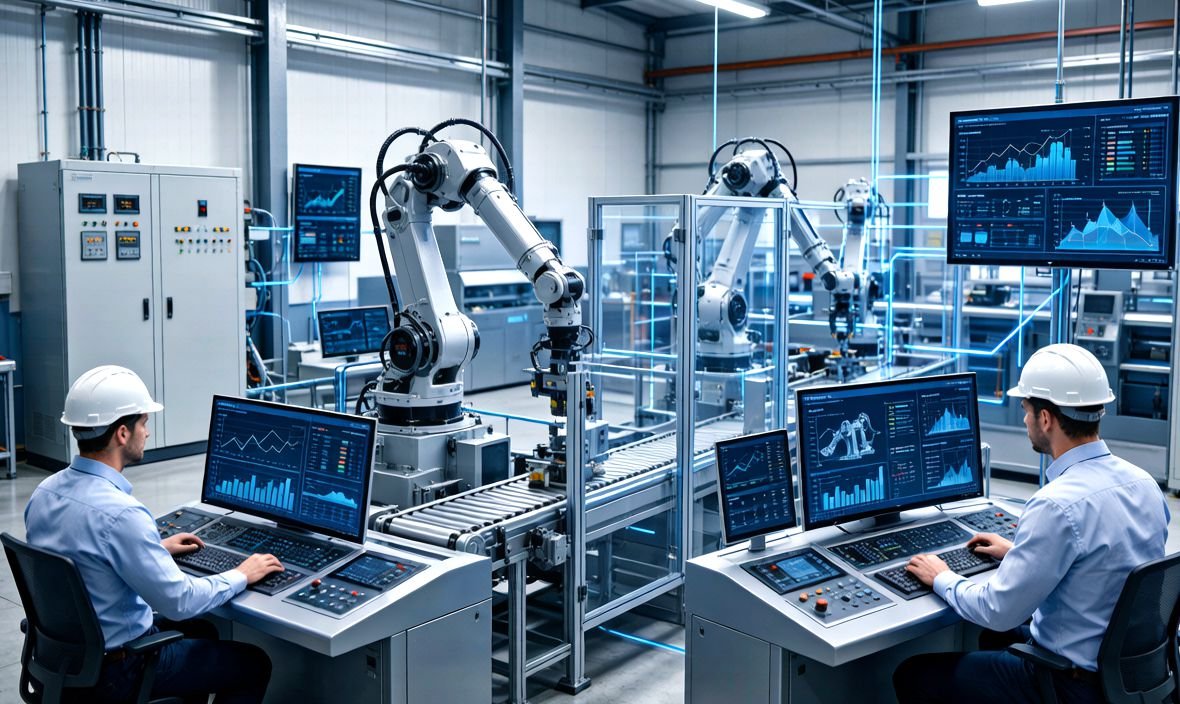
Industrial Automation Market Outlook: Honeywell and Rockwell Compete for Future Growth
The global industrial automation market continues to expand as manufacturers invest in smarter factories, digital transformation, and energy-efficient operations. Companies increasingly adopt PLC, DCS, industrial software, and advanced control systems to improve productivity and reduce operating costs.Honeywell Technologies and Rockwell Automation remain two major players in this market. Both companies provide automation solutions for process industries, manufacturing plants, infrastructure projects, and energy applications. However, their growth paths differ because they focus on different industrial segments.From an industrial automation perspective, Honeywell has stronger exposure to process automation and building technologies. Meanwhile, Rockwell Automation maintains a stronger position in discrete manufacturing, factory automation, and smart production systems.For investors evaluating industrial technology stocks in 2026, comparing their fundamentals, market demand, and automation strategies provides valuable insight.
Honeywell Industrial Automation Business: Strengths and Market Opportunities
Honeywell continues to benefit from increasing demand for automation solutions across commercial buildings, industrial facilities, and energy projects. The company supports customers with control systems, industrial measurement technologies, safety solutions, and process automation platforms.The Building Automation segment shows strong momentum. Growing construction activity in North America, India, and the Middle East creates new opportunities for smart building control systems. In addition, rising investment in data centers and healthcare facilities supports demand for automation equipment.During the second quarter, Honeywell’s Building Automation business achieved 9% organic revenue growth compared with the previous year. The result reflects stronger project activity and increased adoption of intelligent building technologies.The Industrial Automation segment also performed positively. Higher demand for sensing products and industrial measurement solutions helped drive organic revenue growth of approximately 4% year over year.From an engineering perspective, Honeywell benefits from decades of experience in process control environments. Its automation technologies support industries such as oil and gas, chemicals, refining, and power generation, where DCS platforms and safety systems remain essential components.
Honeywell Process Automation Challenges: Pressure on Growth and Margins
Although Honeywell maintains a strong industrial position, its Process Automation and Technology segment faces short-term challenges.The segment reported a 1% organic revenue decline in the second quarter of 2026 after a 6% decline in the first quarter. Lower aftermarket activity, especially reduced refining catalyst shipments, affected overall performance.However, new LNG projects and industrial automation investments provide future growth opportunities. Energy companies continue to modernize facilities with advanced control systems, remote monitoring platforms, and digital optimization tools.Honeywell also faces cost pressure. Rising production expenses and operating costs reduced profitability during the period. The company’s total cost of sales increased year over year, while operating margins declined.In my experience working with industrial automation systems, process industries usually recover slowly after investment cycles weaken. Customers often delay large DCS upgrades but continue investing in maintenance, cybersecurity, and operational improvements.Therefore, Honeywell’s near-term performance depends heavily on the recovery of process industries and large automation projects.
Honeywell Portfolio Restructuring: Impact of Aerospace Separation
Honeywell recently completed a major corporate restructuring strategy. The company separated its Aerospace Technologies business and created independent public companies.The restructuring aims to simplify operations and allow each business unit to focus on its core market opportunities.In addition, Honeywell completed the sale of its warehouse and workflow solutions business. These actions may improve strategic focus, but they could also affect short-term financial comparisons.For industrial automation customers, the key question remains whether Honeywell can accelerate investment in its automation portfolio. Areas such as industrial software, connected control systems, and digital process optimization will determine future competitiveness.
Rockwell Automation Growth Strategy: Strong Position in Factory Automation
Rockwell Automation continues to benefit from strong demand in manufacturing automation. The company specializes in PLC systems, industrial networks, motion control, factory software, and smart manufacturing solutions.Unlike Honeywell’s stronger process industry exposure, Rockwell focuses heavily on discrete and hybrid manufacturing markets. These include automotive, semiconductor, food and beverage, life sciences, and warehouse automation.The company reported strong demand across multiple industrial sectors. Automotive customers continue upgrading production lines, while semiconductor manufacturers increase investment due to artificial intelligence and data center expansion.Rockwell’s e-Commerce and Warehouse Automation business also remains a major growth driver. Many companies prefer upgrading existing warehouses instead of building completely new facilities.This trend creates demand for PLC-based control systems, industrial Ethernet networks, robotics integration, and manufacturing execution systems.
Rockwell Automation Technology Advantages in Smart Manufacturing
Rockwell has built a strong reputation in factory automation through its Allen-Bradley PLC platforms, industrial control systems, and digital manufacturing solutions.Modern factories increasingly require integrated automation architectures. These systems combine PLC controllers, industrial communication networks, robotics, sensors, and cloud-based analytics.Rockwell’s ecosystem supports manufacturers moving toward Industry 4.0 strategies. Customers can improve production visibility, predictive maintenance, and operational efficiency through connected automation platforms.Moreover, Rockwell continues expanding its automation solutions for life sciences and food production industries. These sectors require strict process control, traceability, and regulatory compliance.Based on industrial project experience, manufacturers often select Rockwell solutions when they need flexible factory automation platforms with strong local support networks.
Rockwell Automation Financial Outlook: Pricing Strategy and Market Risks
Rockwell continues improving profitability through productivity programs and pricing strategies. The company expects pricing adjustments to offset tariff impacts during fiscal 2026.Management raised its fiscal 2026 sales growth outlook, supported by stronger demand across key industries. The company also increased its adjusted earnings forecast.However, challenges remain. The Lifecycle Services segment continues experiencing weaker demand because some customers delay large capital projects.Many manufacturers currently prioritize smaller modernization projects rather than complete factory expansions. Therefore, automation suppliers must provide scalable solutions that deliver measurable returns.Rockwell’s ability to combine hardware, software, and lifecycle services will determine its long-term competitiveness.
Honeywell vs Rockwell Automation: Industrial Automation Investment Comparison
From an industrial technology perspective, both companies have attractive long-term opportunities. However, their strengths come from different automation markets.
Category
Honeywell Technologies
Rockwell Automation
Main Market
Process automation, building automation, industrial measurement
Factory automation, PLC, manufacturing systems
Key Industries
Oil and gas, chemicals, energy, infrastructure
Automotive, semiconductor, food, life sciences
Automation Strength
DCS, safety systems, process control
PLC, motion control, smart manufacturing
Growth Driver
LNG projects, building technology, industrial measurement
Factory upgrades, digital manufacturing, AI-related investment
Main Challenge
Process automation slowdown and margin pressure
Weak lifecycle service demand
Honeywell provides strong industrial diversification, but current earnings pressure creates uncertainty. Rockwell benefits from stronger factory automation demand and clearer manufacturing growth trends.Therefore, from a growth perspective, Rockwell Automation appears better positioned for industrial automation expansion in 2026.
Industrial Automation Industry Trend: PLC, DCS, and Digital Transformation
The competition between Honeywell and Rockwell reflects a larger industry transformation.Industrial customers are moving beyond traditional automation upgrades. They now require integrated solutions combining PLC controllers, DCS platforms, industrial cybersecurity, cloud analytics, and artificial intelligence.Process industries continue improving DCS systems for safety, efficiency, and regulatory compliance. Meanwhile, manufacturers invest heavily in flexible factory automation and robotics.The future industrial automation market will favor companies that successfully combine hardware expertise with software capabilities.Both Honeywell and Rockwell understand this trend. However, Rockwell currently has stronger momentum in smart factory applications, while Honeywell remains highly competitive in process industries.
Energy companies use Honeywell automation platforms for refinery control, LNG processing, and safety instrumented systems. These applications require stable DCS operation, advanced monitoring, and reliable process optimization.
Automotive Smart Factory Automation
Automotive manufacturers use Rockwell PLC systems, industrial networks, and motion control technologies to improve production flexibility. These solutions support robotic assembly, quality inspection, and production scheduling.
Semiconductor Manufacturing Automation
Semiconductor plants require precise environmental control, high equipment availability, and advanced factory automation. Both companies support this market through industrial control technologies and digital solutions.
Final Analysis: Rockwell Automation Shows Stronger Near-Term Upside
Honeywell remains a respected industrial automation company with extensive process control experience and a broad technology portfolio. However, challenges in process automation demand and recent restructuring create short-term uncertainty.Rockwell Automation benefits from stronger manufacturing investment trends, especially in automotive, semiconductor, warehouse automation, and smart factories.For investors seeking exposure to industrial automation growth, Rockwell currently presents a more favorable outlook due to stronger demand visibility and better alignment with factory digitalization trends.However, industrial automation markets remain cyclical. Long-term success will depend on innovation, customer adoption, and the ability to deliver integrated PLC, DCS, and digital control solutions.
Durst and TUM Venture Labs Build a New Industrial Automation Ecosystem
Durst Group has started a multi-year cooperation with TUM Venture Labs to accelerate innovation in robotics, artificial intelligence, and industrial automation. The partnership connects industrial experience with deep-tech research capabilities from the Technical University of Munich and UnternehmerTUM.As a Platinum Partner of TUM Venture Labs, Durst becomes the first Italian company to join this innovation network. The cooperation focuses on the Robotics/AI Lab in Munich, which supports developments in robotics, embedded systems, AI technologies, and factory automation.For modern manufacturers, this collaboration reflects a major shift. Traditional production systems based on isolated machines are gradually evolving into connected control systems that integrate data, software, automation hardware, and intelligent algorithms.
Industrial Automation Moves Toward Intelligent Production Platforms
Durst is developing its intelligent production platform Kyveris™, which combines machines, software, operational data, and artificial intelligence. The platform aims to create a more connected manufacturing environment with improved production visibility and process control.Moreover, the AuRo-Layer technology extends automation capabilities from digital systems into the physical production area. It integrates robotics, automated material handling, and autonomous workflows directly into factory operations.From an industrial automation perspective, this approach follows the development direction of Industry 4.0. Modern factories increasingly combine PLC systems, DCS architectures, industrial networks, and AI-based optimization tools to improve efficiency and flexibility.
Robotics and AI Improve Factory Automation Capabilities
The cooperation between Durst and TUM Venture Labs focuses on practical industrial challenges. These challenges include intelligent robotics, autonomous systems, human-machine interaction, simulation technology, embedded AI, and digital twin applications.In real production environments, robotics and AI must work together with existing control systems. Engineers need to consider PLC communication, industrial safety requirements, motion control accuracy, and real-time data processing.Therefore, successful automation projects require more than advanced algorithms. They also require deep knowledge of mechanical engineering, electrical control, production processes, and system integration.
Smart Control Systems Connect Machines, Data and Artificial Intelligence
Durst’s Kyveris™ concept represents a broader industry trend toward learning production systems. These systems collect operational data, analyze production conditions, and support continuous process improvement.In traditional factory automation, PLC controllers execute predefined logic based on programmed instructions. However, intelligent production systems add another layer by using AI models and data analytics to optimize processes.For example, manufacturers can combine machine condition data, production parameters, and digital simulation results to improve maintenance planning and reduce unexpected downtime.This development creates new opportunities for industrial automation suppliers, including PLC manufacturers, DCS providers, robotics companies, and industrial software developers.
Industry Collaboration Accelerates Automation Innovation
According to Christoph Gamper, CEO and Co-Owner of Durst Group, future production environments will become more connected, adaptive, and autonomous. He emphasizes that collaboration between industry, research organizations, startups, and engineering teams will drive the next generation of manufacturing technology.Dr. Philipp Gerbert, CEO of TUM Venture Labs, highlights that robotics and AI achieve practical value when they solve real industrial problems.The cooperation creates a platform where researchers, engineers, entrepreneurs, and manufacturers can exchange ideas. As a result, new automation solutions can move from laboratory concepts into industrial applications faster.
Based on industrial automation development experience, successful smart factory projects require strong integration between hardware and software. Robotics systems must communicate effectively with PLC controllers, safety systems, industrial networks, and manufacturing execution platforms.Moreover, companies must evaluate factors such as system reliability, cybersecurity, lifecycle management, and operator requirements before implementing autonomous production technologies.Durst’s cooperation model provides a practical example of how manufacturers can combine mechanical engineering knowledge with modern automation technologies. This approach can support applications beyond the printing industry, including packaging, manufacturing, logistics, and process industries.
Future Trends: From Automated Machines to Learning Production Systems
The industrial automation market is moving from simple machine automation toward intelligent and adaptive manufacturing systems. Technologies such as AI-based control, digital twins, industrial IoT, and autonomous robotics will continue influencing factory design.However, companies should adopt these technologies based on actual production requirements rather than following technology trends alone. A successful transformation requires clear objectives, skilled engineers, and a well-planned automation architecture.The cooperation between Durst and TUM Venture Labs demonstrates an important industry direction: the future factory will not only execute programmed tasks but also analyze data, optimize operations, and continuously improve production performance.
These solutions demonstrate how industrial automation technologies can transform traditional factories into connected, data-driven production environments.