


Overview
Hardware Specifications
| Parameter | Specification |
|---|---|
| Model | 3300/40-13-01-01-00-00 |
| Base Model | 3300/40 |
| Brand | Bently Nevada |
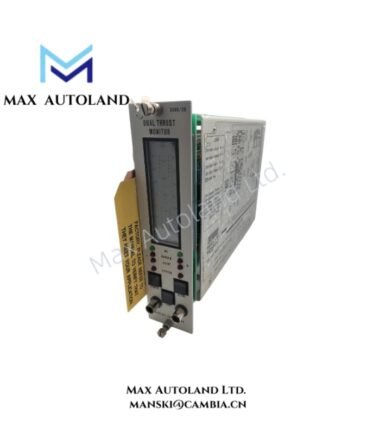
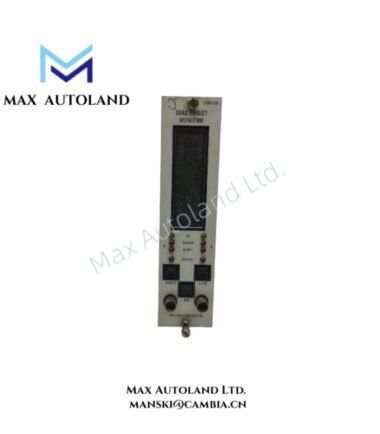
| Product Type | Eccentricity Monitor Module |
| System | 3300 Machinery Protection and Monitoring System |
| Measurement Functions | Direct and peak-to-peak eccentricity |
| Proximity Probe Input Impedance | 10 kOhm |
| Keyphasor Input Impedance | 90 kOhm (manual threshold) |
| Signal Scale | Jumper-selectable; typically 100 mV/mil (4 V/mm) |
| Peak-to-Peak Frequency Response | 0.017 Hz to 10 Hz (1 to 600 cpm) |
| Direct Eccentricity Frequency Response | 0 Hz to 10 Hz (0 to 600 cpm) |
| Measurement Accuracy | Typically +/- 0.33% of full scale; maximum +/- 1% at 25 deg C |
| Recorder Outputs | +4 to +20 mA, 0 to -10 VDC, or +1 to +5 VDC, depending on configuration |
| Alarm Setpoints | Independent Alert and Danger settings, adjustable from 0% to 100% of full scale |
| Setpoint Repeatability | Within +/- 0.4% of full scale |
| Display | Vertical bargraph LCD |
| Operating Temperature | 0 to +65 deg C |
| Storage Temperature | -40 to +85 deg C |
| Relative Humidity | Up to 95%, non-condensing |
| Power Consumption | Nominal 1.5 W |
| Dimensions | 2.0 x 8.0 x 1.0 in (5.1 x 20.3 x 2.5 cm) |
| Weight | 3 lb 5 oz (1.5 kg) |
| Country of Manufacture | United States |
Measurement and Signal Processing
The monitor evaluates two aspects of shaft eccentricity. Peak-to-peak eccentricity measures cyclic changes in the probe signal, while direct eccentricity represents its average or static component within the configured measurement range. Their different frequency responses support the evaluation of slow shaft movement and recurring eccentricity variations.
The proximity probe measures shaft displacement relative to the probe tip. The Keyphasor signal provides a rotational reference where required by the measurement configuration. Correct probe scaling and signal setup help ensure that the monitor reports meaningful eccentricity values.
Outputs and Alarm Indication
The module provides recorder outputs for direct and peak-to-peak eccentricity. Depending on the configured option, the outputs use +4 to +20 mA, 0 to -10 VDC, or +1 to +5 VDC, proportional to the programmed full-scale range. Front-panel buffered outputs provide access to raw eccentricity and Keyphasor signals for testing and signal verification.
The monitor supports independently adjustable Alert and Danger setpoints. Its LCD bargraph displays measurement levels, while the OK, Alert, Danger, and Bypass indicators show monitor status. The installed rack relay hardware and configured logic determine how the system handles alarm outputs.
Configuration and Replacement Checks
Before replacing an existing module, verify the complete part number, transducer input configuration, measurement range, output scaling, and alarm settings. Also confirm that the replacement matches the installed rack and the required monitoring arrangement. Do not assume that modules with the same base model have identical measurement or output configurations.
Frequently Asked Questions
Q: What does the 3300/40 Eccentricity Monitor measure?
A: It measures direct and peak-to-peak shaft eccentricity through a proximity probe signal. These values help personnel evaluate rotor bow and shaft movement during slow rotation.
Q: What should I check before ordering a replacement?
A: Confirm the complete model number, probe sensitivity, measurement range, output configuration, and alarm settings. Match these details to the installed system before ordering.
Q: Does the module provide analog outputs?
A: Yes. It supports configurable recorder outputs for direct and peak-to-peak eccentricity. Verify the selected output range before connecting external monitoring equipment.


Reviews
There are no reviews yet.