

ABB Modernises Pelican Point Power Station with Next-Generation DCS Control System Technology
ABB Upgrades Power Plant Automation Infrastructure to Improve Operational Performance
ABB has secured a modernisation project with ENGIE Australia to upgrade the distributed control system (DCS) infrastructure at Pelican Point Power Station in South Australia. The project will replace existing Advant controllers with the latest ABB Ability System 800xA AC 800M controllers.The upgrade focuses on improving industrial automation performance, strengthening cybersecurity protection, and enhancing real-time plant monitoring. Moreover, the project allows the power station to maintain existing control functions while adopting newer automation technologies.Pelican Point Power Station plays an important role in South Australia’s energy network. The combined cycle gas turbine (CCGT) facility can generate up to 532 MW of electricity and supplies approximately half of the state’s annual thermal power generation requirements.Modern DCS Control Systems Support Long-Term Power Plant Reliability
Modernising control systems has become a major priority for energy producers worldwide. Many power stations continue operating with legacy PLC and DCS platforms that require upgrades to meet current operational and cybersecurity requirements.ABB’s AC 800M controller provides a modern control platform for process automation applications. The controller integrates with ABB System 800xA, offering improved system management, engineering flexibility, and enhanced diagnostics.In industrial automation environments, upgrading the controller layer can significantly improve plant availability. Therefore, operators can achieve better process visibility while reducing risks associated with aging automation hardware.From practical experience in power automation projects, controller modernisation often delivers value beyond hardware replacement. Engineers can improve maintenance efficiency, simplify troubleshooting, and prepare the facility for future digital transformation initiatives.System 800xA and AC 800M Strengthen Industrial Automation Capabilities
The Pelican Point upgrade will modernise controllers for one gas turbine and the steam turbine system. ABB will replace existing Advant control technology with AC 800M controllers to improve automation performance.The AC 800M platform supports advanced control applications across power generation, water treatment, oil and gas, and manufacturing industries. It provides high-speed processing, flexible communication options, and integration with distributed control architectures.Furthermore, ABB System 800xA enables operators to manage control, electrical systems, safety functions, and asset information through a unified automation platform.For large industrial facilities, integrated control systems reduce operational complexity. They also provide engineers with better access to equipment status, alarms, and performance data.Cybersecurity Improvements Become Critical for Power Automation Systems
Cybersecurity has become a key consideration for modern DCS and factory automation systems. Power plants now require stronger protection against evolving digital threats while maintaining continuous operation.The ABB modernisation project improves the security foundation of Pelican Point’s automation infrastructure. Updated controllers provide a more suitable platform for current cybersecurity practices and future system enhancements.However, cybersecurity improvements must balance protection with operational requirements. Industrial facilities cannot simply apply traditional IT security methods because automation systems require high availability and predictable response times.Therefore, modern control system upgrades should include both hardware improvements and long-term lifecycle management strategies.ABB and ENGIE Continue Long-Term Power Plant Automation Partnership
ABB has supported Pelican Point Power Station through an ABB Care agreement since 2019. The partnership provides maintenance support, technical expertise, and opportunities for automation system improvement.Long-term service agreements help industrial operators extend equipment lifecycle and maintain stable production performance. In addition, they allow automation suppliers to identify upgrade opportunities before aging systems affect plant operations.ENGIE Australia stated that the modernisation project supports improved efficiency, reliability, and long-term asset value. The upgrade also prepares Pelican Point for future energy market requirements.This type of collaboration represents a growing trend across the power industry. Operators increasingly combine automation upgrades with lifecycle services to maintain competitive performance.Energy Demand Growth Drives Power Plant Control System Modernisation
Australia’s electricity demand continues to increase as industries expand and energy consumption patterns change. According to forecasts from the Australian Energy Market Operator (AEMO), electricity demand may grow significantly by 2030.As a result, existing power plants must improve operational efficiency and maintain reliable electricity supply. Modern DCS platforms provide important tools for achieving these goals.Power generation facilities are increasingly adopting advanced PLC, DCS, and industrial automation solutions to improve flexibility. These technologies help operators manage changing loads, optimize maintenance schedules, and increase operational transparency.In my view, power plant modernisation is no longer only about replacing outdated controllers. It represents a broader strategy that combines automation technology, cybersecurity, and asset management.Application Scenario: DCS Modernisation for Existing Power Generation Facilities
A typical DCS upgrade project involves several technical stages:1. Existing System Assessment Engineers evaluate current controllers, communication networks, I/O modules, and control strategies before migration.2. Controller Replacement and Configuration Legacy Advant controllers or older PLC systems are replaced with modern platforms such as ABB AC 800M.3. Control Logic Migration Existing process sequences, interlocks, and operating functions are transferred and tested to maintain plant availability.4. System Testing and Commissioning Engineers verify control performance, communication reliability, alarm functions, and operator interfaces.5. Future Digital Integration Modern automation platforms provide a foundation for advanced analytics, predictive maintenance, and industrial digitalisation.This approach applies not only to power plants but also to chemical facilities, manufacturing factories, water treatment plants, and other process industries.Conclusion: Modern Automation Creates a More Flexible Energy Future
ABB’s Pelican Point Power Station project demonstrates the importance of continuous automation system evolution. By upgrading DCS controllers and improving cybersecurity capabilities, the facility can maintain stable operation while preparing for future energy challenges.For industrial operators, modern PLC and DCS technologies provide a practical path toward improved efficiency, better asset management, and stronger operational resilience.As global energy systems become more complex, control system modernisation will remain a key investment area for power generation companies and industrial automation users.
Emerson Ovation Curation Tool Enhances Digital Twin Synchronization for Industrial Automation
Emerson Develops New Solution for Control System and Digital Twin Management
Emerson has introduced the Ovation Curation Tool, a software solution designed to improve synchronization between Ovation control systems and digital twin environments. The tool helps industrial organizations manage configuration changes, maintain version history, and improve digital twin accuracy.In modern industrial automation, digital twins support operator training, engineering validation, process optimization, and control strategy testing. However, these virtual environments must remain consistent with real-world control systems, PLC, DCS platforms, and factory automation networks to deliver accurate results.As power and water facilities continue upgrading their automation infrastructure, maintaining alignment between operational systems and simulation platforms has become a growing challenge. Emerson’s new solution addresses this issue by automating change tracking and synchronization workflows.Digital Twin Synchronization Challenges in Industrial Automation
Digital twin technology has become an important component of modern industrial automation strategies. Companies use digital replicas of their production systems to improve safety, reduce downtime, and optimize operational performance.However, control systems continuously evolve during daily operations. Engineers often adjust DCS configurations, modify control logic, update parameters, or improve process sequences to solve operational issues.These changes can gradually create differences between the physical control environment and the digital simulation model. Therefore, engineering teams must regularly compare both systems to maintain accuracy.Traditionally, engineers performed these comparisons manually. This approach required significant time and introduced risks caused by missed updates or undocumented configuration changes.From practical industrial experience, maintaining digital twin consistency becomes more difficult as automation systems expand across multiple units, production lines, and remote facilities.Automated Change Tracking Improves Control System Governance
The Emerson Ovation Curation Tool provides automated monitoring for Ovation-based control environments. Users can schedule synchronization checks weekly, monthly, or according to specific engineering requirements.The software records important configuration information, including:- Modified system parameters
- User activity records
- Change timestamps
- Version history details
Digital Twin Impact Analysis Supports Safer System Updates
Before applying changes, the Ovation Curation Tool provides simulation snapshot impact analysis. This feature allows engineers to evaluate potential effects before deploying updated configurations.The analysis process helps teams understand whether a modification may influence system behavior, simulation accuracy, or operator training scenarios.Therefore, engineers can review possible risks before introducing changes into production environments. This approach supports safer DCS management and reduces unnecessary testing cycles.For power generation and water treatment facilities, where continuous operation is critical, controlled deployment processes can improve operational confidence.Repository-Based Collaboration Supports Factory Automation Workflows
The Ovation Curation Tool uses a repository-based method to manage data movement between production systems and digital twin environments.Multiple engineers can access shared assets, review modifications, and combine approved changes through collaborative workflows. In addition, the repository approach improves traceability across engineering teams.This capability supports organizations that operate complex automation architectures involving:- Distributed Control Systems (DCS)
- PLC-based automation platforms
- Operator training simulators
- Engineering development environments
- Digital twin applications
Digital Twins Become a Foundation for Industrial AI Applications
The growth of industrial artificial intelligence has increased demand for accurate and continuously updated digital twins. AI models require trustworthy operational data and realistic simulation environments to deliver meaningful results.According to industry analysts, open and interoperable digital ecosystems will play a major role in future automation development. Digital twin synchronization technologies can support this transition by keeping engineering models aligned with real production conditions.In my view, digital twins will not replace traditional PLC, DCS, or safety control systems. Instead, they will become an additional engineering layer that helps organizations improve decision-making, testing efficiency, and operational planning.Emerson Ovation Curation Tool Applications in Power and Water Industries
The Ovation platform is widely used in power generation and water infrastructure applications. These industries require stable automation systems because unexpected control changes can affect production reliability and operational safety.Typical application scenarios include:Power Plant Operator TrainingDigital twins allow operators to practice abnormal condition responses without affecting live plant operations. The Curation Tool helps maintain simulator accuracy after control system updates.Control Strategy TestingEngineers can evaluate new DCS strategies in simulation environments before applying changes to operating systems.Engineering Change ManagementAutomation teams can track configuration modifications and maintain consistent documentation throughout the system lifecycle.AI-Based Process OptimizationAccurate digital models provide better foundations for predictive analytics and industrial AI applications.Industry Perspective: Digital Twin Synchronization Will Shape Future Automation
The introduction of Emerson’s Ovation Curation Tool reflects a broader trend in industrial automation. Companies are moving from isolated control systems toward integrated automation ecosystems.Future factories and infrastructure projects will require stronger connections between PLC, DCS, simulation platforms, and enterprise data systems.However, successful digital transformation depends on accurate engineering data and controlled system management. Tools that automate synchronization, version control, and configuration governance will become increasingly valuable.For automation engineers, maintaining alignment between physical systems and digital models will become a standard part of lifecycle management.
Emerson Ovation Curation Tool Improves Digital Twin Synchronization for Power and Water Control Systems
Emerson Introduces New Digital Twin Synchronization Software for Industrial Automation
Emerson has launched the Ovation Curation Tool, a new synchronization solution designed for power and water control systems. The software improves digital twin management by connecting operational control systems with simulation environments.In modern industrial automation, digital twins support engineering analysis, operator training, and system testing. However, maintaining synchronization between a live DCS environment and its digital model remains a major challenge.The Ovation Curation Tool addresses this issue by automatically tracking system modifications and managing configuration changes. Therefore, engineers can maintain accurate digital twin models without performing time-consuming manual comparisons.Digital Twin Management Reduces Control System Configuration Drift
Control system configuration drift occurs when engineers update production systems but fail to update simulation models. Over time, differences between the physical plant and the digital twin can reduce simulation accuracy.For power generation and water treatment facilities, this issue can affect operator training, commissioning activities, and troubleshooting processes. Moreover, outdated simulation data may create risks during system upgrades or operational changes.Emerson designed the Curation Tool to monitor changes across Ovation control systems and digital twin platforms. The software records modifications, identifies differences, and helps engineers maintain consistent system configurations.Automated Version Control Enhances DCS and Control System Engineering
Traditional version management requires engineers to manually compare PLC, DCS, and simulation databases. This process often consumes significant engineering resources, especially in large industrial facilities.The Ovation Curation Tool introduces automated change tracking through a centralized dashboard. Users can review what changed, who made the modification, and when the update occurred.In addition, the system creates an audit history that supports industrial governance requirements. This capability helps organizations improve documentation quality and reduce risks caused by undocumented engineering changes.From practical industrial projects, engineers often spend considerable time verifying control logic differences before testing. Automated comparison tools can significantly improve maintenance efficiency and reduce unnecessary engineering effort.Intelligent Synchronization Supports Power and Water Industry Applications
After engineers validate system changes, the Curation Tool can synchronize updates between production control systems, digital twins, and other Ovation environments.The software includes impact analysis functions before deployment. These functions help engineers evaluate possible effects on target systems and identify potential conflicts.Therefore, plant teams can perform controlled updates with better visibility. This approach supports safer testing, faster troubleshooting, and more accurate operator training.For power plants, this capability is valuable during control strategy optimization, equipment upgrades, and lifecycle management. Water facilities can also use the technology to maintain consistent operational models across multiple systems.Repository-Based Architecture Improves Industrial Automation Data Management
The Ovation Curation Tool uses a repository-based architecture to manage data movement between production systems and simulation platforms.Multiple engineering users can work with the same assets while maintaining controlled synchronization. Moreover, the system supports change merging to improve collaboration among automation teams.This design reflects a growing trend in industrial automation where engineering data management becomes as important as hardware performance. Modern PLC, DCS, and SCADA environments require stronger configuration control to support long-term operation.Digital Twin Technology Becomes More Important in Factory Automation
Digital twin technology continues to expand across industrial automation applications. Manufacturers, utilities, and infrastructure operators increasingly use simulation models for optimization and predictive decision-making.However, the value of a digital twin depends on data accuracy. A disconnected simulation model cannot provide reliable engineering insights.Emerson’s approach highlights an important industry direction: digital twins must become continuously updated operational assets rather than static engineering models.In my experience working with industrial automation systems, synchronization between engineering databases and field operations has always been a difficult task. Solutions that automate configuration tracking can help organizations improve efficiency while maintaining better control system visibility.Emerson Strengthens Industrial Automation Lifecycle Management
Emerson’s Ovation platform is widely used in power generation and water management applications. The introduction of the Curation Tool extends the platform’s capabilities into digital lifecycle management.The solution supports several industrial requirements, including:- Control system version management
- Digital twin synchronization
- Engineering change tracking
- Operator training preparation
- Simulation validation
- Troubleshooting support
- Configuration governance
Application Scenarios for Ovation Curation Tool
Power Plant Digital Twin MaintenanceA power generation company can use the tool to synchronize its Ovation DCS with a training simulator. Engineers can automatically identify control logic changes and update the simulation environment before operator training sessions.Water Treatment Control System OptimizationWater facilities can maintain consistent configurations between operational systems and simulation platforms. This helps engineers test process improvements before applying changes to live systems.Industrial Automation Upgrade ProjectsDuring PLC, DCS, or control system modernization projects, engineers can use automated comparison and impact analysis to reduce commissioning risks.Conclusion: A New Approach to Control System Synchronization
Emerson’s Ovation Curation Tool represents a practical development in industrial automation engineering. By combining automated version control, digital twin synchronization, and change auditing, the solution helps organizations manage increasingly complex control environments.As industrial facilities continue adopting digital twins and advanced DCS technologies, maintaining accurate engineering data will become a key factor in operational performance. Tools that improve synchronization and governance will play an important role in future factory automation strategies.Durst and TUM Advance Smart Industrial Automation with AI and Robotics
Durst and TUM Venture Labs Build a New Industrial Automation Ecosystem
Durst Group has started a multi-year cooperation with TUM Venture Labs to accelerate innovation in robotics, artificial intelligence, and industrial automation. The partnership connects industrial experience with deep-tech research capabilities from the Technical University of Munich and UnternehmerTUM.As a Platinum Partner of TUM Venture Labs, Durst becomes the first Italian company to join this innovation network. The cooperation focuses on the Robotics/AI Lab in Munich, which supports developments in robotics, embedded systems, AI technologies, and factory automation.For modern manufacturers, this collaboration reflects a major shift. Traditional production systems based on isolated machines are gradually evolving into connected control systems that integrate data, software, automation hardware, and intelligent algorithms.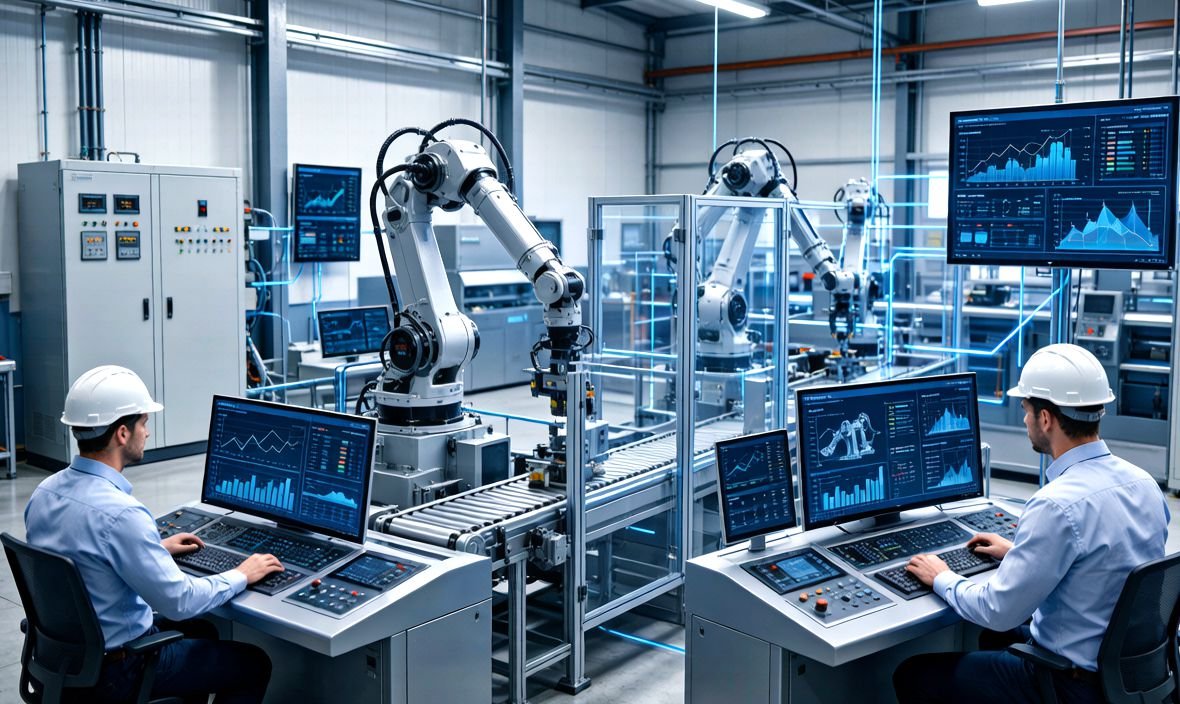
Industrial Automation Moves Toward Intelligent Production Platforms
Durst is developing its intelligent production platform Kyveris™, which combines machines, software, operational data, and artificial intelligence. The platform aims to create a more connected manufacturing environment with improved production visibility and process control.Moreover, the AuRo-Layer technology extends automation capabilities from digital systems into the physical production area. It integrates robotics, automated material handling, and autonomous workflows directly into factory operations.From an industrial automation perspective, this approach follows the development direction of Industry 4.0. Modern factories increasingly combine PLC systems, DCS architectures, industrial networks, and AI-based optimization tools to improve efficiency and flexibility.Robotics and AI Improve Factory Automation Capabilities
The cooperation between Durst and TUM Venture Labs focuses on practical industrial challenges. These challenges include intelligent robotics, autonomous systems, human-machine interaction, simulation technology, embedded AI, and digital twin applications.In real production environments, robotics and AI must work together with existing control systems. Engineers need to consider PLC communication, industrial safety requirements, motion control accuracy, and real-time data processing.Therefore, successful automation projects require more than advanced algorithms. They also require deep knowledge of mechanical engineering, electrical control, production processes, and system integration.Smart Control Systems Connect Machines, Data and Artificial Intelligence
Durst’s Kyveris™ concept represents a broader industry trend toward learning production systems. These systems collect operational data, analyze production conditions, and support continuous process improvement.In traditional factory automation, PLC controllers execute predefined logic based on programmed instructions. However, intelligent production systems add another layer by using AI models and data analytics to optimize processes.For example, manufacturers can combine machine condition data, production parameters, and digital simulation results to improve maintenance planning and reduce unexpected downtime.This development creates new opportunities for industrial automation suppliers, including PLC manufacturers, DCS providers, robotics companies, and industrial software developers.Industry Collaboration Accelerates Automation Innovation
According to Christoph Gamper, CEO and Co-Owner of Durst Group, future production environments will become more connected, adaptive, and autonomous. He emphasizes that collaboration between industry, research organizations, startups, and engineering teams will drive the next generation of manufacturing technology.Dr. Philipp Gerbert, CEO of TUM Venture Labs, highlights that robotics and AI achieve practical value when they solve real industrial problems.The cooperation creates a platform where researchers, engineers, entrepreneurs, and manufacturers can exchange ideas. As a result, new automation solutions can move from laboratory concepts into industrial applications faster.Industrial Automation Experience Supports Real-World Applications
Based on industrial automation development experience, successful smart factory projects require strong integration between hardware and software. Robotics systems must communicate effectively with PLC controllers, safety systems, industrial networks, and manufacturing execution platforms.Moreover, companies must evaluate factors such as system reliability, cybersecurity, lifecycle management, and operator requirements before implementing autonomous production technologies.Durst’s cooperation model provides a practical example of how manufacturers can combine mechanical engineering knowledge with modern automation technologies. This approach can support applications beyond the printing industry, including packaging, manufacturing, logistics, and process industries.Future Trends: From Automated Machines to Learning Production Systems
The industrial automation market is moving from simple machine automation toward intelligent and adaptive manufacturing systems. Technologies such as AI-based control, digital twins, industrial IoT, and autonomous robotics will continue influencing factory design.However, companies should adopt these technologies based on actual production requirements rather than following technology trends alone. A successful transformation requires clear objectives, skilled engineers, and a well-planned automation architecture.The cooperation between Durst and TUM Venture Labs demonstrates an important industry direction: the future factory will not only execute programmed tasks but also analyze data, optimize operations, and continuously improve production performance.Application Scenarios: Intelligent Factory Automation Solutions
Potential applications of this collaboration include:- Automated material handling: Robotics systems can transport components and products while communicating with factory control systems.
- AI-based process optimization: Production data can support automatic parameter adjustment and quality improvement.
- Digital twin integration: Virtual factory models can simulate production changes before physical implementation.
- Predictive maintenance: Machine data analysis can help identify equipment issues before failures occur.
- Flexible manufacturing lines: Intelligent automation enables faster product changes and customized production.

ABB Recognized as a Leader in 2025 Industrial IoT Platforms Driving AI-Powered Industrial Automation
ABB Named a Leader in the 2025 Gartner Magic Quadrant for Global Industrial IoT Platforms
ABB Strengthens Industrial Automation Leadership in Gartner IoT Evaluation
ABB has been named a Leader in the 2025 Gartner Magic Quadrant for global Industrial IoT platforms. The recognition highlights ABB’s strong position in industrial automation and digital transformation. Moreover, it confirms the company’s consistent performance in industrial AI and connected systems. Therefore, ABB continues to strengthen its role in data-driven factory automation and process industries.Gartner Magic Quadrant Context for Industrial IoT and Control Systems
The Gartner Magic Quadrant evaluates technology vendors across high-growth industrial software markets. It classifies providers into Leaders, Visionaries, Challengers, and Niche Players. Moreover, Leaders demonstrate strong execution and a clear long-term strategy. In addition, the framework helps industrial buyers assess industrial automation and control systems platforms objectively. As a result, ABB’s position signals strong credibility in global industrial IoT ecosystems.ABB Genix Platform for Industrial IoT and Data Integration
ABB’s recognition is strongly linked to its ABB Genix Industrial IoT and AI Suite platform. The Genix platform integrates operational technology, information technology, and engineering systems. Moreover, it enables real-time data contextualization across industrial automation environments. Therefore, it supports predictive analytics, performance optimization, and AI-driven decision-making. In factory automation environments, this improves operational visibility and system responsiveness.AI-Driven Industrial Automation and Predictive Maintenance Capabilities
Genix supports advanced use cases such as predictive maintenance and digital twins. Moreover, it helps industries improve asset reliability and reduce unplanned downtime. Engineers can apply AI models to process and discrete manufacturing systems. Therefore, control systems become more adaptive and data-driven over time. In addition, industrial operators gain better decision support across PLC and DCS environments.Modular Architecture Supporting Cloud, Edge, and Hybrid Deployment
The Genix platform uses a modular architecture designed for scalable industrial deployment. It supports cloud, edge, and hybrid computing models. Moreover, this flexibility allows integration with existing industrial automation infrastructure. Therefore, companies can modernize systems without replacing core control systems. In addition, APIs and Industrial DataOps layers enable seamless data exchange between platforms.Ecosystem Strategy and Enterprise Integration in Factory Automation
ABB expands Genix through partnerships with major technology providers such as Microsoft and Red Hat. These collaborations enhance cloud integration and industrial cybersecurity capabilities. Moreover, they support large-scale deployment across energy, maritime, and manufacturing industries. Therefore, ABB strengthens its ecosystem approach in global factory automation markets. In addition, enterprise integration improves scalability for multi-site industrial operations.Author Insight on Industrial AI and Automation Market Direction
Industrial automation is moving toward autonomous operations driven by AI and real-time data. However, many legacy PLC and DCS systems still lack full contextual integration. ABB’s Genix platform addresses this gap by combining industrial AI with operational data. Moreover, the focus on modularity reflects a broader industry shift toward software-defined control systems. In my view, vendors that unify AI, data, and control will dominate future factory automation landscapes.ABB Company Position in Global Industrial Automation Market
ABB is a global leader in electrification and industrial automation technologies. The company focuses on improving efficiency, sustainability, and operational performance. Moreover, its Process Automation division supports energy, water, and manufacturing industries. Therefore, ABB continues to influence next-generation industrial control system architectures. In addition, its long-term digital strategy aligns with autonomous and connected industrial operations.Application Cases and Industrial Automation Solution Scenarios
ABB Genix enables predictive maintenance in energy production facilities and process plants. It also supports digital twin modeling in large-scale manufacturing environments. Moreover, maritime operators use it to optimize equipment performance and fuel efficiency. Therefore, industrial operators can integrate AI insights directly into PLC and DCS workflows. As a result, factories achieve higher uptime, improved safety, and optimized production efficiency.
Global Industrial Robot Demand Accelerates as Factory Automation Reaches Record Scale
Global Robot Demand in Factories Doubles Over 10 Years
Global Industrial Automation and Robot Installation Growth Trends
The latest IFR World Robotics 2025 report confirms strong global expansion in industrial automation. International Federation of Robotics reported 542,000 industrial robot installations in 2024.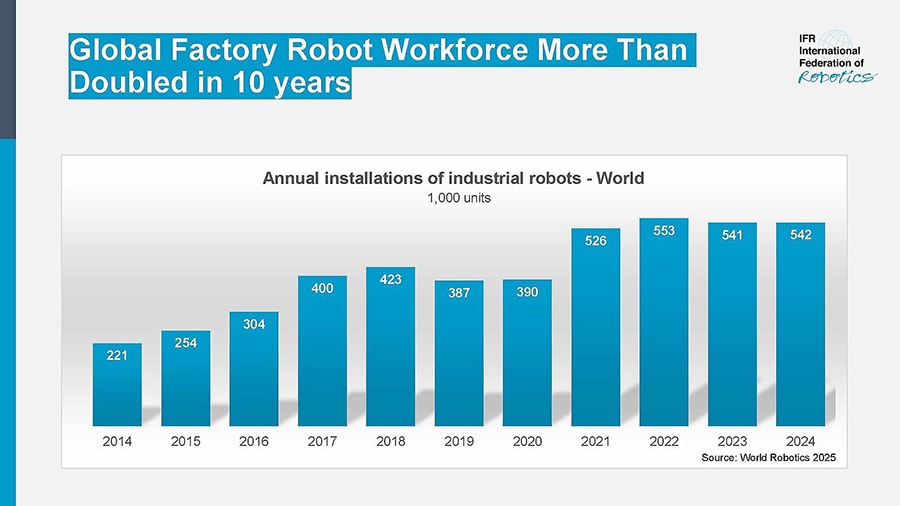
Asia Dominates Industrial Automation Robot Deployment
Asia remains the largest region for industrial robot adoption. It accounts for approximately 74% of global installations in 2024.China leads the global market with 295,000 new installations. Moreover, it represents more than half of global robot deployment activity.China’s domestic manufacturers increased market share to 57%. As a result, local supply chains now dominate industrial automation expansion.Japan remains the second-largest market with 44,500 installations. However, demand shows slight short-term fluctuation due to economic cycles.South Korea recorded 30,600 installations in 2024. Meanwhile, India continues strong growth driven by automotive factory automation.From a control systems perspective, Asia is rapidly scaling PLC-based production lines. This supports higher efficiency in large-scale manufacturing ecosystems.European Industrial Automation and Factory Robotics Trends
Europe recorded 85,000 industrial robot installations in 2024. Although this represents an 8% decline, it remains historically high.Germany leads the region with nearly 27,000 installations. Moreover, it accounts for about one-third of Europe’s total demand.Italy, Spain, and France follow as major automation markets. However, performance varies due to automotive and manufacturing cycles.Nearshoring strategies continue to support European factory automation investment. Therefore, industrial control systems remain a key modernization driver.From an engineering standpoint, European manufacturers prioritize precision and safety. This increases demand for advanced DCS and robotics integration.Industrial Robot Growth in the Americas Manufacturing Sector
The Americas region installed over 50,000 industrial robots in 2024. However, this reflects a moderate decline compared to the previous year.United States remains the largest regional market. It accounts for 68% of total installations in the Americas.Mexico and Canada follow, driven mainly by automotive manufacturing. Moreover, investment cycles strongly influence annual installation patterns.The United States relies heavily on imported robotics systems. However, system integrators play a critical role in deployment success.From a factory automation view, integration capability matters more than hardware origin. Therefore, PLC and control system expertise becomes essential.Industrial Automation Technology Drivers and Market Outlook
Industrial robot demand continues to grow despite economic uncertainty. Global GDP growth remains stable between 2.9% and 3.1%.However, geopolitical risks and supply chain disruption create volatility. In addition, automation investment cycles differ across regions.Experts expect 575,000 robot installations in 2025. Moreover, long-term projections exceed 700,000 units by 2028.Industrial automation continues to evolve toward AI-driven production systems. Therefore, robotics integration with PLC and smart control systems becomes standard.From my perspective, manufacturers increasingly view automation as resilience infrastructure. It is no longer only a productivity enhancement tool.Author Insight on Industrial Automation and Robotics Expansion
Industrial robotics adoption reflects a structural transformation in manufacturing. Factories now prioritize flexibility, data integration, and digital control systems.Moreover, integration between robotics, PLC, and DCS is becoming tighter. This improves synchronization across complex production environments.However, regional inequality in adoption still exists. Therefore, system integrators play a key role in knowledge transfer.Overall, industrial automation is entering a mature but expanding phase. It combines robotics, AI, and advanced control architectures.Application Cases in Factory Automation Systems
Industrial robots are widely used in automotive assembly lines. They improve welding, painting, and precision assembly operations.Moreover, electronics manufacturing relies on high-speed robotic handling systems. This ensures consistent quality in mass production environments.In logistics and e-commerce, robots optimize packaging and sorting workflows. Therefore, factory automation reduces operational cost and human workload.These applications demonstrate the integration of robotics with control systems. They also highlight the importance of PLC and DCS coordination.
Siemens and Machine Tool Manufacturers Launch Industrial AI Data Alliance for Smart Factory Automation
Siemens and Machine Builders Agree on Data Alliance
Siemens Expands Industrial AI Strategy with Manufacturing Data Collaboration
Siemens has formed a major industrial AI alliance with leading machine tool manufacturers and research institutions. The partnership focuses on sharing engineering, production, and machine data to accelerate generative AI innovation in industrial automation.The alliance includes Grob, Trumpf, Chiron, Renishaw, Heller, Voith Group, and RWTH Aachen University’s Machine Tool Laboratory (WZL).This collaboration supports Siemens’ long-term vision for its Industrial Foundation Model, first introduced at Hannover Messe 2025.The initiative also reflects the growing importance of AI in factory automation, PLC systems, DCS control systems, and advanced manufacturing environments.Industrial AI Becomes a Strategic Priority for European Manufacturing
Siemens CEO Roland Busch emphasized that industrial AI offers significant opportunities for Europe’s industrial economy.Industries such as automotive, chemicals, pharmaceuticals, energy, healthcare, transportation, and mechanical engineering increasingly rely on intelligent automation technologies. Therefore, manufacturers require scalable AI systems capable of handling complex industrial workflows.The alliance aims to unlock new productivity levels by combining high-quality industrial data with generative AI technologies.From an industry perspective, access to trusted manufacturing data remains one of the most important requirements for successful industrial AI deployment.Shared Machine Data Improves Generative AI Performance
The participating companies will exchange anonymized machine and manufacturing data under strict cybersecurity and data protection standards.This data will help train AI models specifically designed for industrial environments. Unlike general-purpose AI systems, industrial AI models must understand machine behavior, production workflows, and engineering processes.As a result, specialized industrial foundation models can provide more accurate recommendations for factory automation and control systems applications.Moreover, the collaboration highlights a growing trend toward secure industrial data ecosystems that support AI innovation without compromising operational security.Automated NC Programming Enhances Manufacturing Efficiency
One important application involves the automatic generation of NC programs for machine tools.NC programs control machining operations and provide detailed production instructions for industrial equipment. Traditionally, programmers spend significant time creating and optimizing this code manually.Generative AI can simplify this process by creating machine programs faster while reducing coding errors. Consequently, engineers can focus more on advanced manufacturing tasks and process optimization.For industrial automation environments, automated programming may improve production flexibility and shorten product development cycles.AI Supports Predictive Maintenance and Adaptive Manufacturing
The alliance also plans to develop AI solutions for predictive maintenance and adaptive manufacturing.Predictive maintenance systems analyze machine data to identify potential equipment failures before breakdowns occur. Therefore, manufacturers can reduce unplanned downtime and improve asset reliability.In addition, adaptive manufacturing systems can adjust machine parameters automatically based on changing production conditions.These capabilities closely align with modern smart factory strategies that integrate AI, IoT sensors, PLC controllers, and DCS infrastructure into connected production environments.From a technical perspective, AI-driven manufacturing optimization could significantly improve energy efficiency and operational stability.Industrial Data Quality Remains Essential for AI Success
Roland Busch highlighted that high-quality machine data from multiple manufacturers plays a critical role in industrial AI development.Industrial environments generate enormous amounts of operational data every day. However, fragmented data structures often limit the effectiveness of AI systems.By creating a shared industrial data ecosystem, Siemens and its partners aim to improve AI accuracy across engineering, manufacturing, and maintenance applications.This approach may also encourage broader standardization within industrial automation and smart manufacturing industries.IT and OT Integration Accelerates Smart Factory Development
The alliance further supports the growing convergence of Information Technology (IT) and Operational Technology (OT).Modern manufacturing facilities increasingly connect enterprise software with factory-level control systems. Consequently, AI platforms must integrate smoothly with PLC systems, MES software, SCADA platforms, and industrial IoT networks.Industrial AI models that understand both operational and engineering data can improve decision-making across the entire production lifecycle.This convergence also strengthens digital twin applications, autonomous manufacturing, and real-time production analytics.Industry Perspective: Industrial AI Could Reshape Manufacturing Operations
The manufacturing industry continues to face labor shortages, rising production costs, and stronger global competition.Therefore, companies increasingly invest in AI-driven industrial automation technologies to improve productivity and operational resilience.The Siemens-led alliance demonstrates how collaborative industrial ecosystems may accelerate AI adoption across multiple sectors.From an industry viewpoint, companies that combine trusted industrial data with scalable AI infrastructure may gain long-term competitive advantages in smart manufacturing.Moreover, Europe’s industrial sector could strengthen its technological leadership through open collaboration between machine builders, software providers, and research organizations.Real-World Application Scenarios for Industrial AI
The alliance’s industrial AI technologies may support applications such as:- Automated NC programming for machine tools
- Predictive maintenance in factory automation systems
- AI-driven quality inspection and process optimization
- Energy-efficiency management in industrial facilities
- Digital twin simulation for production environments
- Adaptive manufacturing using real-time machine data
- Smart robotics and autonomous production systems
- Industrial analytics integrated with PLC and DCS platforms
Conclusion
The Siemens industrial AI alliance marks an important milestone for smart manufacturing and industrial automation development.By combining machine data, engineering expertise, and generative AI technologies, the partnership aims to create more intelligent and adaptive manufacturing systems.In addition, the initiative demonstrates how industrial AI, factory automation, PLC systems, and advanced control technologies continue converging into fully connected smart factory ecosystems.As manufacturers pursue greater efficiency, sustainability, and flexibility, industrial AI alliances like this may shape the future of global manufacturing innovation.
How Micro Data Centers Are Powering Smart Manufacturing and Industrial Automation
Why Micro Data Centers Are the Unsung Heroes of Smart Manufacturing
Smart Manufacturing Creates Massive Demand for Edge Computing
Modern automotive factories now depend heavily on software, AI, and connected industrial automation systems. Production lines generate enormous amounts of operational data every day. Therefore, manufacturers require faster and more reliable computing infrastructure.Today’s factory automation environments use robotics, machine vision systems, PLC controllers, and AI-based quality inspection tools. These technologies continuously exchange real-time data across production networks.As a result, even small delays in data processing can interrupt operations, reduce productivity, or create quality issues. Manufacturers increasingly rely on edge computing to solve these challenges.Micro Data Centers Bring Computing Closer to Industrial Operations
Traditional centralized data centers often sit far away from manufacturing facilities. However, smart factories require ultra-low latency processing directly near the production floor.Micro data centers solve this problem by placing compute power closer to industrial equipment. These compact systems combine servers, networking, storage, cooling, and security into one integrated solution.Unlike traditional server rooms, modern micro data centers support modular deployment and rapid scalability. In addition, companies can install them with minimal disruption to ongoing production.This localized infrastructure helps manufacturers process industrial data faster while improving operational reliability.Factory Automation Requires Real-Time Data Processing
Modern manufacturing systems depend on continuous communication between machines, sensors, and industrial control systems.For example, robotics systems, DCS platforms, SCADA software, and automated testing equipment require immediate responses to changing production conditions. Therefore, edge infrastructure becomes essential for maintaining stable operations.Micro data centers help manufacturers process machine data locally rather than sending information to remote cloud environments. Consequently, factories reduce latency while improving decision-making speed.This capability becomes especially important in high-speed automotive manufacturing environments where downtime costs can reach millions of dollars per hour.Compact Industrial Infrastructure Supports Space-Constrained Facilities
Manufacturing plants often face limited floor space and strict operational requirements. Therefore, industrial IT infrastructure must remain compact and flexible.Micro data centers address these concerns through space-efficient designs. Some units support wall-mounted installations or integration inside industrial enclosures.Moreover, manufacturers can deploy these systems directly near PLC cabinets, robotics cells, or factory automation equipment. This approach improves network performance and reduces cabling complexity.For facilities expanding digital transformation initiatives, modular infrastructure also simplifies future upgrades.Operational Resilience Improves Manufacturing Continuity
Industrial operations require maximum uptime. Even short interruptions can disrupt supply chains and reduce production output.Micro data centers include built-in redundancy, environmental monitoring, and failover protection. As a result, manufacturers improve operational resilience during power fluctuations or network disruptions.In addition, edge infrastructure supports predictive maintenance applications by enabling continuous monitoring of industrial equipment.Many manufacturers now combine edge computing with AI-driven analytics to identify equipment failures before they occur. This proactive strategy reduces unplanned downtime and maintenance costs.Cybersecurity and Data Protection Remain Critical Priorities
Cybersecurity threats continue to increase across industrial automation environments. Therefore, manufacturers must protect sensitive operational data and production systems.Micro data centers strengthen both physical and digital security through secure enclosures, restricted access controls, and isolated network architectures.Local data processing also improves data sovereignty because critical operational information stays inside the facility. Consequently, manufacturers reduce exposure to external cybersecurity risks.For industries such as automotive, pharmaceuticals, and energy, secure edge infrastructure has become an essential operational requirement.IT and OT Convergence Accelerates Smart Factory Development
The convergence of Information Technology (IT) and Operational Technology (OT) continues to reshape industrial automation strategies.Traditionally, IT teams managed enterprise systems while OT engineers handled factory equipment and control systems. However, modern smart manufacturing requires close integration between both environments.Micro data centers help bridge this gap by connecting enterprise analytics with real-time industrial operations.This infrastructure allows PLC systems, DCS platforms, MES software, and cloud applications to exchange data efficiently across the factory floor.From an operational perspective, successful IT/OT integration improves visibility, scalability, and production optimization.Edge Computing Supports EV Manufacturing and Autonomous Systems
The rapid growth of electric vehicle production increases demand for advanced computing infrastructure. New battery factories, autonomous systems, and AI-enabled production lines require faster local processing capabilities.Automated guided vehicles (AGVs), robotics platforms, and machine vision systems all depend on ultra-low latency communication. Therefore, edge computing infrastructure becomes critical for next-generation manufacturing environments.Private 5G networks also continue expanding across smart factories. Micro data centers naturally complement these networks by providing localized compute and storage resources.As a result, manufacturers gain more flexibility for real-time industrial automation applications.Industry Analysis: Edge Infrastructure Will Shape Future Manufacturing
The manufacturing sector continues to face rising labor costs, supply chain instability, and stronger global competition.At the same time, companies must improve sustainability performance while increasing production efficiency. Therefore, manufacturers increasingly invest in intelligent factory automation and edge computing infrastructure.Micro data centers support these goals by enabling predictive analytics, digital twins, AI-based monitoring, and real-time process optimization.From an industry perspective, companies that modernize edge infrastructure today will likely gain stronger operational resilience and long-term competitive advantages.Real-World Application Scenarios for Micro Data Centers
Manufacturers across multiple industries already use micro data centers for:- Automotive production and EV battery manufacturing
- AI-driven quality inspection systems
- Industrial robotics and AGV operations
- Predictive maintenance platforms
- DCS and SCADA monitoring systems
- Pharmaceutical and life sciences facilities
- Smart warehouse automation
- Energy management and sustainability monitoring
Conclusion
Micro data centers have become essential infrastructure for smart manufacturing and industrial automation.These compact edge computing systems support real-time processing, operational resilience, cybersecurity, and scalable factory automation strategies. In addition, they help manufacturers integrate AI, digital twins, PLC systems, and advanced analytics more efficiently.As automotive and industrial sectors continue evolving toward autonomous and data-driven operations, edge-ready infrastructure will play an increasingly strategic role in future manufacturing success.
AMD Joins Digital Twin Consortium to Advance AI-Powered Edge Computing for Industrial Automation
Digital Twin Consortium Welcomes AMD to Accelerate AI-Powered Digital Twin Innovation at the Edge
AMD Expands Its Role in Digital Twin and Edge AI Technologies
Digital Twin Consortium (DTC) has announced that AMD joined the organization to support next-generation AI-powered digital twin innovation. The collaboration aims to accelerate intelligent edge computing across industrial automation, factory automation, and smart infrastructure environments.AMD will contribute advanced AI processing technologies, including Ryzen AI processors and ROCm software, to strengthen digital twin deployment at the industrial edge. As industries demand faster analytics and autonomous operations, edge AI becomes increasingly important for real-time decision-making.This partnership also highlights the growing convergence between AI, digital twins, PLC systems, and industrial control systems.Digital Twin Technology Continues to Evolve in Industrial Automation
Digital twin technology has rapidly moved beyond simulation and visualization. Today, companies use digital twins for predictive maintenance, operational optimization, and autonomous process management.As a result, manufacturers and infrastructure operators now integrate digital twin platforms directly with DCS, SCADA, and factory automation systems.AMD’s participation in DTC reflects this industry transition. The company focuses on enabling intelligent computing directly at the edge rather than relying entirely on cloud infrastructure.This approach helps organizations reduce latency, strengthen cybersecurity, and improve operational reliability.Ryzen AI Processors Support Intelligent Edge Applications
AMD recently introduced major innovations through its Ryzen AI processor series and ROCm 7 open-source software platform. These technologies support high-performance AI workloads while improving local processing efficiency.The hybrid architecture combines neural processing units (NPUs) with integrated GPU capabilities. Therefore, industrial users can deploy sophisticated AI agents directly on edge devices.For industrial automation environments, local AI processing offers practical advantages. Facilities can analyze machine data in real time without transferring sensitive operational information to external cloud systems.This capability becomes especially valuable for mission-critical industries such as energy, manufacturing, and healthcare.Open-Source AI Frameworks Improve Digital Twin Flexibility
AMD also promotes open-source AI development through projects such as Minions and Lemonade Server.Minions, developed by Stanford University’s Hazy Research Group, enables collaboration between large cloud-based AI models and smaller local AI systems. Meanwhile, Lemonade Server allows local large language models to run efficiently on AMD Ryzen AI platforms with NPU acceleration.These frameworks support composable digital twin architectures. In addition, they help organizations scale AI deployments from pilot projects to enterprise-wide industrial systems.From a technical perspective, open-source ecosystems often accelerate innovation because developers can adapt solutions for specialized industrial requirements.AI Agents and Multi-Agent Systems Transform Factory Automation
DTC recently introduced its AI Agent Capabilities Periodic Table framework to support advanced AI agent deployment. AMD’s edge AI technologies align closely with this initiative.The company’s hardware architecture enables Multi-Agent Generative Systems (MAGS) to operate locally in industrial environments. Consequently, digital twin systems can process data, coordinate operations, and respond to changing conditions with minimal human intervention.This development could significantly impact industrial automation and robotics applications. Smart factories increasingly require autonomous systems that can manage production efficiency, equipment diagnostics, and quality control simultaneously.Moreover, edge-based AI agents improve response times for safety-critical industrial operations.Industrial Edge AI Strengthens Security and Data Sovereignty
One important advantage of edge AI involves data sovereignty. Many industrial companies prefer local data processing because operational information remains within their own infrastructure.AMD’s strategy supports this requirement by enabling AI inference directly on industrial PCs and embedded systems. Therefore, organizations can maintain stronger control over sensitive operational data.In addition, predictable local computing costs may reduce long-term cloud expenses for large-scale digital twin deployments.For sectors such as utilities, oil and gas, and pharmaceutical manufacturing, these factors remain critical during digital transformation projects.Industry Perspective: Open Standards Will Shape Future Digital Twin Adoption
Digital Twin Consortium continues to focus on interoperability, cybersecurity, and open standards development. AMD’s commitment to open-source frameworks aligns with these objectives.In industrial automation, interoperability remains essential because facilities often combine equipment from multiple vendors. PLC controllers, DCS systems, robotics platforms, and IoT devices must exchange data efficiently across operations.The industry increasingly favors flexible architectures rather than isolated proprietary systems. Therefore, partnerships between technology providers, industrial software developers, and research organizations will likely accelerate innovation.From an operational perspective, companies adopting open and scalable digital twin platforms may achieve faster deployment cycles and lower integration costs.Application Scenarios for AI-Powered Digital Twins
AI-powered digital twin systems can support multiple industrial applications, including:- Predictive maintenance in manufacturing plants
- Autonomous robotics and humanoid systems
- Smart energy management and SMR operations
- Real-time monitoring of factory automation equipment
- Healthcare and life sciences asset management
- Industrial process optimization using DCS and SCADA platforms