
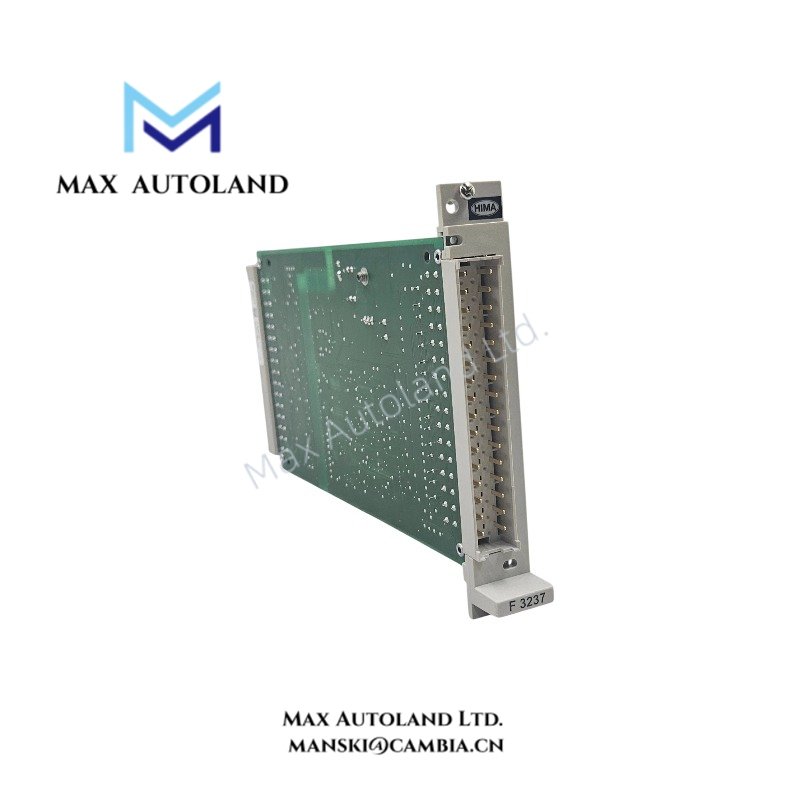
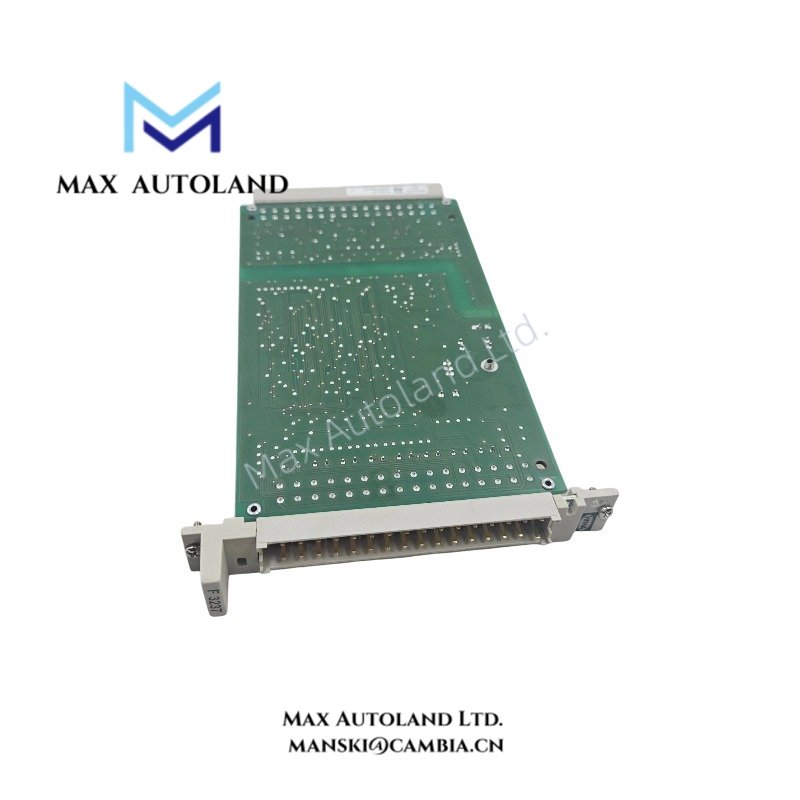
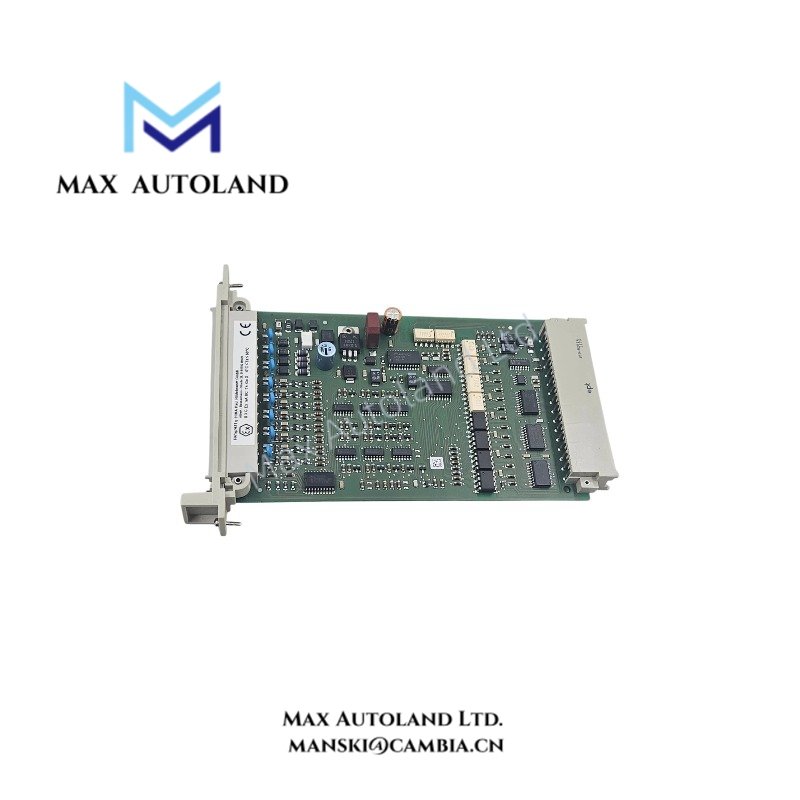
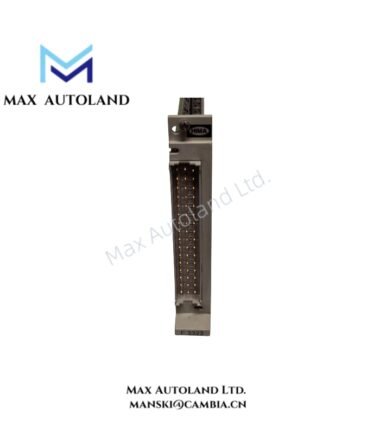
Overview
Hardware Specifications
| Parameter | Specification |
|---|---|
| Model | F 3237 |
| Brand | HIMA |
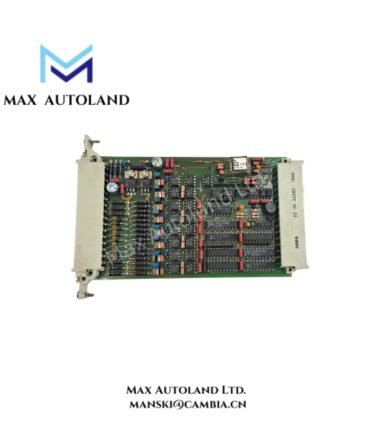
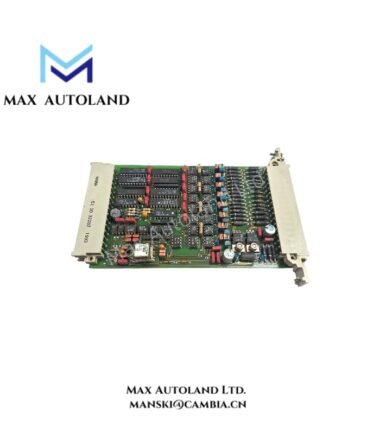
| Product Type | Safety-Related Proximity Switch Input Module |
| Input Channels | 8 |
| Safety Requirement Class | AK 1 to 6 |
| Switching Time | Approximately 10 ms |
| Logic 0 Input Current | 0.35 to 1.2 mA |
| Logic 1 Input Current | 2.1 to 6.0 mA |
| Wire Break Threshold | 0.28 mA or less |
| Short Circuit Threshold | 6.5 mA or more |
| Maximum Line Impedance | 50 ohm |
| Maximum Line Length | 1000 m with 0.5 mm2 cable |
| Sensor Supply Voltage | 8.2 V |
| Shunt Resistors | 681 ohm, 1% tolerance, 0.25 W |
| Shunt Resistor Positions | R17 to R24 |
| Shunt Resistor Part Number | 00 0751681 |
| Space Requirement | 4 TE |
| 5 V Supply Current | 90 mA |
| 24 V Supply Current | 170 mA |
| Line Monitoring | Short-circuit and wire-break detection |
| Automatic Self-Tests | Switching capability, input crosstalk, input filters, module function, sensor line faults |
| Associated Software Block | HB-RTE-; verify the applicable operating system version |
| Stock Status | 1 unit in stock |
| Country of Origin | Germany |
| Estimated Shipping Dimensions | 19.8 x 14.2 x 2.5 cm |
| HS Code | 8537101190 |
Signal Processing and Line Monitoring
The F 3237 evaluates sensor current to distinguish logic states and wiring faults. The specified current ranges define the operating thresholds: 0.35 to 1.2 mA represents a logic 0, while 2.1 to 6.0 mA represents a logic 1. Currents at or below 0.28 mA indicate a wire break, and currents at or above 6.5 mA indicate a short circuit.
The specified maximum line impedance is 50 ohm, with a maximum cable length of 1000 m when using 0.5 mm2 cable. These limits should be checked against the selected sensor, cable resistance, and installation configuration.
Automatic Diagnostic Functions
During operation, the module automatically tests its main functions. The diagnostic routines check switching on and off, input-circuit crosstalk through a walking-zero test, input filter operation, overall module function, and sensor line faults.
The LED functions are not included in the automatic tests. Therefore, LED indication should not be treated as independently verified by the module’s built-in diagnostic routines.
Sensor Compatibility and Shunt Resistor
The module supports DIN 19234 (NAMUR) proximity switches and resistor-wired sensors. However, some proximity switches do not meet the current characteristics defined by this standard. The original technical information gives the Pepperl+Fuchs NJ 5-30GK-S1N as an example of a sensor whose undamped-state current may be too low for the expected wire-break monitoring behavior.
For this specific case, the documentation describes connecting a 47 kohm resistor in parallel to increase the undamped-state output current to 170 uA. The resistor arrangement is intended to preserve line-break detection: an open resistor circuit is also detected as a line break, while a genuine sensor-line break remains detectable.
Verify the selected sensor’s current characteristics and the applicable circuit diagram before applying this modification. Do not assume that the 47 kohm resistor is required for every sensor or that it applies to all proximity switch types.
Frequently Asked Questions
Q: How many sensors can the HIMA F 3237 connect?
A: The module has 8 input channels for supported proximity switches and resistor-wired sensors. Confirm the sensor wiring and current characteristics for each channel before commissioning.
Q: Can the F 3237 detect both short circuits and wire breaks?
A: Yes. It monitors sensor-line current, with a wire-break threshold of 0.28 mA or less and a short-circuit threshold of 6.5 mA or more. Correct detection depends on the sensor and wiring meeting the specified electrical conditions.
Q: What should be checked when using a non-standard NAMUR proximity switch?
A: Check the sensor’s undamped-state current and its behavior under line-break supervision. The documented 47 kohm parallel-resistor arrangement applies to the described low-current case; verify its suitability for the actual sensor and circuit before use.

Reviews
There are no reviews yet.