Case Study: Environmental Monitoring as the Silent Guardian of Data Center Uptime
Environmental Monitoring Has Become Critical for Data Center Reliability
Modern data centers power artificial intelligence, cloud services, financial platforms, and enterprise applications.These facilities host mission-critical servers, storage hardware, and networking systems that must operate continuously.Therefore, even a brief disruption can trigger financial losses, compliance exposure, and reputational damage.Many organizations prioritize power redundancy and cybersecurity. However,
environmental monitoring plays an equally important role in protecting uptime.For this reason, leading operators increasingly integrate temperature and humidity monitoring into broader
industrial automation and infrastructure strategies.
Temperature Control Protects Critical IT Equipment from Hidden Risks
Servers generate large amounts of heat during normal operation.Without sufficient cooling, temperatures can rise beyond safe operating limits.Consequently, hardware may throttle performance, malfunction, or shut down unexpectedly.Even short overheating events can corrupt data or shorten equipment lifespan.This challenge resembles thermal management issues found in
factory automation, PLC cabinets, DCS rooms, and industrial control systems.In both environments, stable operating conditions directly influence system reliability.
Humidity Management Reduces Corrosion and Electrostatic Damage
Humidity control presents another critical challenge for high-availability facilities.When humidity levels rise excessively, condensation can form on electronic assemblies.As a result, operators may face corrosion, electrical shorts, or component failure.Conversely, extremely dry environments increase electrostatic discharge risk.Static discharge can damage sensitive circuit boards, processors, and communication equipment.Therefore, precise humidity control supports both equipment protection and operational continuity.
Energy Efficiency Depends on Intelligent Environmental Control Systems
Many operators attempt to avoid overheating through aggressive cooling strategies.However, excessive cooling increases energy consumption and operating costs.A more sustainable approach relies on precise measurement and adaptive environmental management.This strategy increasingly depends on
control systems, SCADA platforms, and industrial automation architectures.Real-time monitoring enables HVAC systems to maintain stable environmental conditions without unnecessary energy use.Consequently, facilities can improve both efficiency and operational resilience.
Industry Standards Define Safe Environmental Operating Ranges
Industry organizations such as
ASHRAE provide recommended environmental guidelines for data center operations.Most facilities target:
- Temperature: 18°C–27°C (64°F–80°F)
- Relative Humidity: 40%–60% RH
These ranges help operators balance thermal protection, energy efficiency, and equipment reliability.Moreover, documented environmental control supports service-level agreements and regulatory expectations.For organizations managing mission-critical infrastructure, environmental compliance increasingly carries business importance.
Sensor Placement Determines Environmental Monitoring Accuracy
Accurate environmental monitoring begins with effective sensor deployment.Poor placement often creates misleading measurements and delayed responses.Therefore, engineers position monitoring devices at critical airflow and thermal locations.Common installation points include:
- Rack inlets and outlets
- Cold aisles and hot aisles
- Raised floor air plenums
- Ceiling return ducts
- UPS and battery rooms
This layered monitoring strategy provides stronger environmental visibility across the facility.In addition, dense sensor placement enables faster anomaly detection.
Data Centers Benefit from Multiple Monitoring Architectures
Modern facilities rarely depend on a single monitoring method.Instead, operators combine several environmental monitoring models.Typical approaches include:
- Spot monitoring: fixed point measurements
- Zone monitoring: multi-area environmental analysis
- Mobile monitoring: temporary diagnostic assessment
Each method supports different operational requirements.Consequently, engineers often design hybrid monitoring strategies for large-scale facilities.This approach closely mirrors practices used across
industrial control systems and advanced process automation environments.
DCIM Integration Strengthens Industrial Automation Performance
Environmental sensors generate greater value when operators connect them to
Data Center Infrastructure Management (DCIM) platforms.DCIM software uses real-time data to optimize cooling, energy consumption, and facility performance.Therefore, sensor interoperability becomes essential.Many facilities prefer transmitters that support open industrial protocols and standard outputs.Common interfaces include:
- 4–20mA analog signals
- HART communication
- Modbus connectivity
These communication methods integrate smoothly with
SCADA, PLC, DCS, and industrial automation control systems.As a result, operators can unify environmental management with broader facility automation.
Real-Time Environmental Monitoring Delivers Measurable Operational Benefits
Continuous monitoring creates clear operational advantages.Facilities that track temperature and humidity in real time can respond faster to environmental deviations.Key benefits include:
- Reduced downtime risk
- Longer equipment lifespan
- Improved HVAC efficiency
- Stronger SLA and compliance support
- Better operational visibility
Moreover, predictive monitoring helps operators identify developing issues before failures occur.This proactive model increasingly defines modern high-availability infrastructure management.
Moore Industries HTZ Supports Continuous Temperature and Humidity Monitoring
Some facilities deploy dedicated industrial transmitters for long-term environmental control.One example involves the
Moore Industries HTZ Humidity and Temperature Transmitter.The compact, loop-powered device measures both temperature and humidity with strong accuracy and repeatability.Originally developed for semiconductor cleanroom applications, the HTZ also suits data centers that demand uninterrupted performance.Its programming simplicity, industrial durability, and installation flexibility support mission-critical environments.
Case Study: Large-Scale Data Center Deploys Dense Environmental Monitoring Network
A large data center project required continuous environmental management for high-density server operations.The design team needed to maintain stable temperature and humidity conditions across multiple operational zones.Therefore, engineers installed monitoring points throughout:
- Cold aisles
- Hot aisles
- Areas above server racks
- Areas below server racks
- HVAC supply and return ducts
This architecture enabled complete environmental coverage across critical airflow pathways.Moreover, it improved visibility into cooling system effectiveness.
Challenge: Precision Environmental Control Leaves No Margin for Error
The project team faced strict humidity management requirements.Operators needed to maintain relative humidity between 40% and 60%.Humidity below 40% increased electrostatic discharge risk.Humidity above 60% increased condensation exposure.Because the facility required uninterrupted operation, the monitoring system needed high accuracy, strong scalability, and dependable long-term performance.Furthermore, engineers required a deployment model that supported dense sensor coverage.
Solution: Industrial-Grade HTZ Transmitters Enable Reliable Monitoring
The project team selected the
Moore Industries HTZ transmitter platform.The device offered several operational advantages:
- Stable humidity and temperature measurement
- 4–20mA output with HART communication
- Rugged industrial construction
- Low maintenance requirements
- Long-term operational reliability
Each facility deployed roughly 150 measurement points.This configuration created extensive environmental visibility across critical data center zones.Consequently, operators could identify abnormal thermal or humidity trends rapidly.
Results: Continuous Environmental Data Supports 24/7 Data Center Uptime
The monitoring deployment produced measurable operational improvements.The data center maintained humidity within recommended operating ranges.In addition, the facility reduced risks related to electrostatic discharge and condensation-driven equipment damage.Dense monitoring coverage also supported:
- Lower downtime exposure
- Fewer maintenance interventions
- Continuous HVAC optimization
- Stronger operational redundancy
High-resolution environmental data enabled teams to make faster, data-driven decisions.Therefore, the facility strengthened both reliability and operational efficiency.
Industry Perspective: Environmental Monitoring Acts as the Silent Guardian of Digital Infrastructure
Environmental monitoring rarely receives the same attention as power systems or cybersecurity.However, temperature and humidity control directly influence uptime, efficiency, and asset longevity.As data centers continue scaling for AI, cloud computing, and digital services, operators will need tighter environmental visibility.This trend creates new opportunities for
industrial automation, PLC, DCS, SCADA, and intelligent control systems technologies.From an engineering perspective, environmental monitoring no longer represents a secondary utility function.Instead, it has become a foundational pillar of resilient digital infrastructure.
Application Scenario: Integrating Environmental Monitoring into Automated Data Center Operations
Consider a hyperscale data center expanding server density to support AI workloads.Traditional cooling practices may struggle with thermal variability and energy costs.By integrating industrial-grade transmitters with
DCIM, PLC, SCADA, or control systems, operators can achieve:
- Real-time environmental intelligence
- Adaptive HVAC optimization
- Faster anomaly detection
- Improved energy performance
- Higher infrastructure uptime
- Scalable facility automation
This model demonstrates how
industrial automation technologies increasingly support the future of mission-critical data center operations.

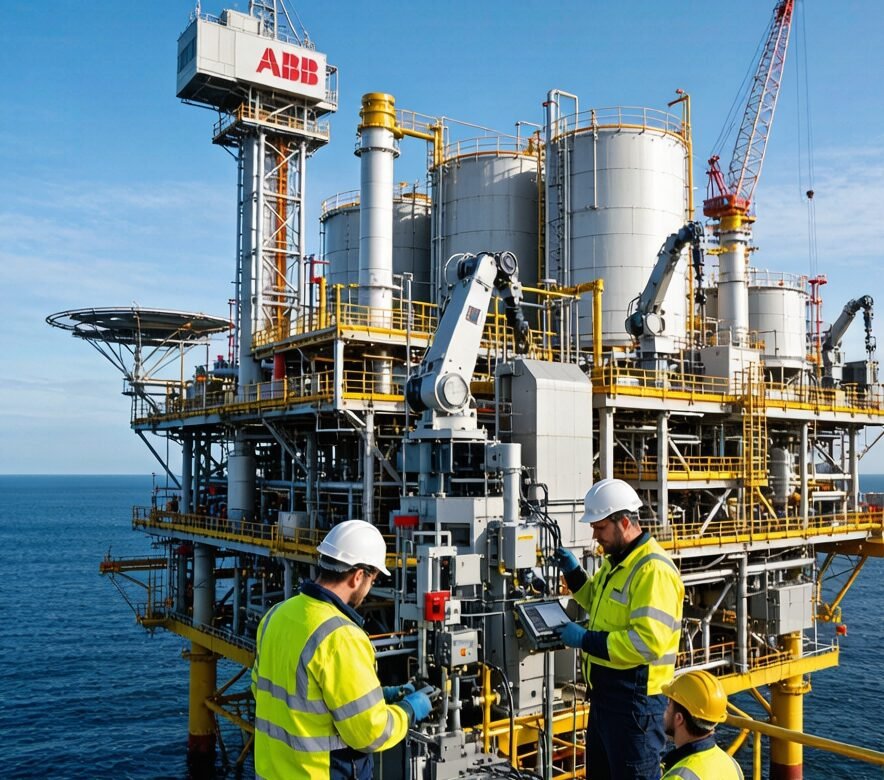
 Offshore Control Room Upgrade: ABB Engineers Commissioning System 800xA at the Buzzard Platform