The USA Drops to No. 4 Globally in Cybersecurity Knowledge
Global Cybersecurity Rankings Highlight U.S. Gaps
The United States now ranks 4th worldwide in cybersecurity and online privacy knowledge, according to the 2025 National Privacy Test (NPT) by NordVPN. The survey analyzed 30,792 participants across 186 countries, revealing strengths and weaknesses in digital security practices. While Americans excel at recognizing suspicious service offers and creating strong passwords, they struggle with emerging threats such as AI-related privacy risks.
Americans Excel in Basic Security but Lag in AI Awareness
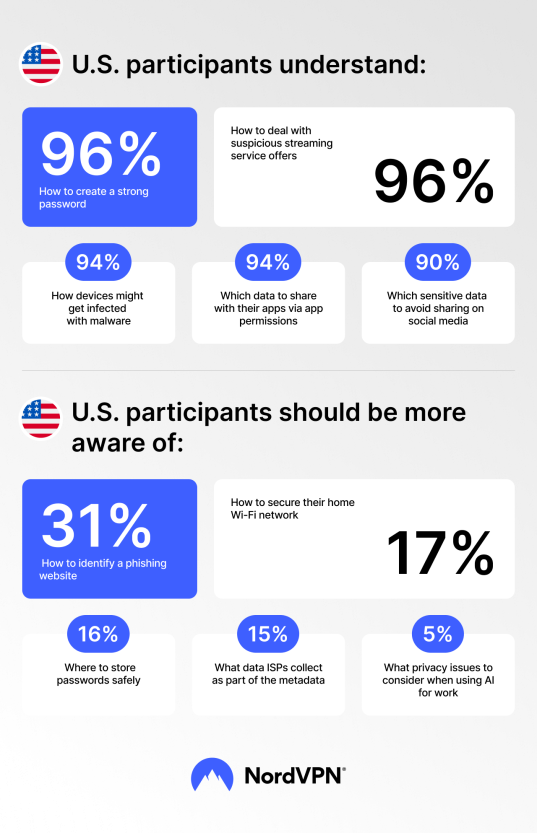
The survey highlights that 96% of Americans can identify suspicious streaming service offers and create strong passwords. Additionally, 94% understand malware risks and app permissions, while 90% know which sensitive data to avoid sharing online. However, only 5% recognize privacy concerns when using AI at work. These gaps could affect industrial automation environments where AI-driven control systems increasingly manage sensitive production data.
Cybersecurity Categories: From Cyber Wanderers to Cyber Stars
In the U.S., 68% of respondents fall into the “Cyber Adventurer” category, showing solid knowledge but room for improvement. Only 1% are “Cyber Wanderers” with minimal awareness, while 13% are “Cyber Stars,” slightly above the global average of 10%. This distribution suggests that most professionals in industrial automation may have a foundational understanding but need targeted training for advanced threats.
Key Areas for Improvement in Industrial Settings
Americans’ awareness has improved in some areas, including online privacy tools (up 7 points to 37%) and AI-powered scam recognition (up 5 points to 76%). However, only 16% know safe password storage methods, 17% can secure home Wi‑Fi networks, and 31% identify phishing websites. For industrial control systems, these gaps highlight the importance of structured cybersecurity protocols, including network segmentation and access control for PLCs and DCS.
Practical Steps to Strengthen Security in Factories
Marijus Briedis, CTO at NordVPN, recommends several measures to enhance online security:
- Implement strong, unique passwords for all accounts and industrial system interfaces.
- Enable multi-factor authentication (MFA) for remote access to PLCs, SCADA, and DCS systems.
- Regularly update software and firmware to mitigate vulnerabilities in industrial control systems.
- Use secure VPN connections when accessing factory networks remotely.
- Review privacy settings on all connected devices, including IoT sensors and AI tools.
- Invest in continuous cybersecurity education for staff operating industrial automation systems.
Industry Implications and Recommendations
As industrial automation increasingly integrates AI and IoT technologies, cybersecurity gaps in the workforce could lead to data breaches, production downtime, or even safety risks. Companies should proactively address these weaknesses by combining technical safeguards with employee training. Investing in cybersecurity awareness aligns with industry best practices and regulatory standards such as IEC 62443 for industrial control systems.
Applications in Industrial Automation
- Smart Factory Security: Ensuring AI-driven robots and PLCs operate within secure network environments.
- DCS Data Protection: Safeguarding sensitive operational data from phishing or malware attacks.
- SCADA Network Segmentation: Isolating control networks from corporate networks to reduce risk exposure.
By prioritizing cybersecurity awareness and implementing practical safeguards, U.S. industrial companies can maintain operational integrity and lead in secure factory automation.