Global Industrial Robot Demand Reaches a New Scale
Industrial automation is entering a new commercial phase as factories increase spending on robotic production systems. According to the International Federation of Robotics (IFR), companies installed 542,000 industrial robots worldwide during 2024. That figure more than doubled the installation level recorded a decade earlier. (IFR International Federation of Robotics)The IFR also reported a global industrial robot installation value of $16.7 billion. Asia represented 74% of new installations, while Europe accounted for 16%. The Americas represented another 9% of global deployments. (IFR International Federation of Robotics)These figures show that factory automation has moved beyond isolated technology demonstrations. Manufacturers now evaluate robots through productivity, availability, maintenance cost, and integration performance.For industrial operators, the question has changed. They no longer ask whether robots can perform a task. Instead, they ask whether robotic systems can perform that task consistently within an existing control architecture.That distinction matters for PLC, DCS, SCADA, motion control, and safety systems. A robot becomes commercially useful only when it integrates effectively with the wider industrial control environment.

AI Robotics and Industrial Automation: Trends, Integration & Growth
AI Robotics Moves From Demonstrations to Production
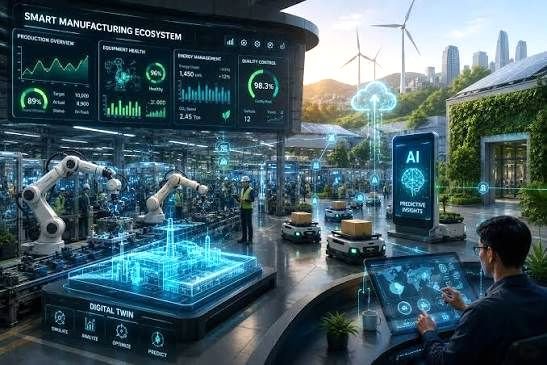
Artificial intelligence is changing how engineers design and operate robotic systems. Traditional industrial robots typically follow predefined programs and deterministic motion sequences. AI-enabled systems can add vision, adaptive planning, and data-driven decision functions.The IFR identifies AI and autonomy as major robotics trends for 2026. It also highlights the growing convergence between information technology and operational technology. (IFR International Federation of Robotics)This convergence has direct implications for factory automation. Robot controllers increasingly exchange information with PLCs, industrial Ethernet networks, MES platforms, edge computers, and cloud services.However, AI does not remove the need for deterministic control. A PLC or safety controller still handles defined interlocks, emergency functions, sequencing, and machine-state logic.In my experience with industrial control systems, successful automation projects separate these responsibilities clearly. AI can optimize decisions, while conventional control systems maintain predictable machine behavior.
Factory Automation Must Integrate With Existing Control Systems
A production robot rarely operates as an independent machine. Engineers normally connect it to conveyors, sensors, safety devices, PLCs, drives, vision systems, and production databases.Therefore, integration quality often determines project success more than robot specifications.A typical factory cell may use a PLC for sequence control and a robot controller for motion execution. Industrial Ethernet can connect both systems, while safety I/O handles protective functions.DCS platforms may supervise larger process operations. PLC-based control often handles discrete manufacturing equipment and machine-level sequences.The same principle applies to AI robotics. New systems must fit into the plant's existing automation hierarchy instead of creating another isolated control layer.
Labor Shortages Continue to Accelerate Automation
Labor availability has become a major factor behind industrial automation investment. Manufacturers face difficulties filling repetitive, physically demanding, or low-availability positions.The IFR identifies labor shortages as one of the major global robotics trends for 2026. It notes that companies increasingly view robots as tools for addressing workforce gaps. (IFR International Federation of Robotics)This trend affects more than production lines. Warehousing, food processing, hospitality, packaging, and logistics operations also face staffing constraints.Automation therefore offers two complementary benefits. It can reduce repetitive manual work while allowing employees to focus on inspection, maintenance, supervision, and process improvement.However, companies should not treat robotics as a simple labor replacement project. The strongest results usually come from redesigning workflows around people and machines together.
Safety Validation Becomes More Important With AI
AI introduces additional engineering questions because autonomous systems can make decisions that conventional programmed robots cannot.The IFR therefore highlights safety, cybersecurity, testing, and human oversight as major concerns for AI-enabled robotics. (IFR International Federation of Robotics)Factory engineers must consider safety-rated control functions, protective guarding, emergency stops, access monitoring, and safe robot operating zones.Cybersecurity also becomes more important when robots connect to industrial networks or cloud platforms. The attack surface can expand when operational technology exchanges data with external systems.For this reason, AI should operate within a controlled automation architecture. Safety functions should remain clearly defined and independently validated where required.
PLC and DCS Engineers Remain Central to Robot Integration
The growth of AI robotics does not eliminate traditional industrial automation technologies. Instead, it increases the need for skilled control engineers.PLCs remain important for machine sequencing, discrete I/O, interlocking, diagnostics, and equipment coordination. DCS platforms continue to manage process control, plant supervision, and large-scale operational data.Robot controllers handle coordinated motion, trajectory generation, tool control, and application-specific programming. Vision systems provide inspection and positioning information.The engineering challenge involves connecting these technologies without creating unnecessary complexity.A well-designed system establishes clear ownership for each control function. That architecture improves troubleshooting and reduces unexpected interactions between automation layers.
Robotics-as-a-Service Changes the Automation Investment Model
Upfront capital cost remains a significant barrier for many automation projects. Robotics-as-a-Service, or RaaS, offers another commercial model.Under RaaS, customers can pay recurring fees instead of purchasing the complete robotic system immediately. This model can reduce the initial capital requirement for selected applications.The IFR reported strong growth in service robotics and identified subscription and rental models as an increasingly important part of the market. Professional service robot sales reached nearly 200,000 units in 2024. (IFR International Federation of Robotics)The proposed TechForce-NBR framework also includes an RaaS structure. Participating operators could potentially purchase systems after a 24-month term, subject to final commercial conditions. (雅虎财经)For manufacturers, this model can simplify technology evaluation. However, buyers should still examine lifecycle cost, service response, software fees, spare parts, and system availability.
Industrial Automation Buyers Should Measure More Than Robot Count
Robot quantity alone does not demonstrate automation success. A factory can install hundreds of robots and still achieve poor operational results.Manufacturers should instead monitor several engineering indicators.These include cycle time, overall equipment effectiveness, mean time between failures, mean time to repair, energy consumption, scrap rate, and unplanned downtime.Safety performance also requires continuous monitoring. Therefore, acceptance testing should include both production performance and safety requirements.Integration quality deserves similar attention. Engineers should verify PLC communication, robot handshakes, sensor diagnostics, network availability, and recovery procedures.
Conclusion: Factory Automation Is Moving Toward Proof and Scale
Global robot installations demonstrate that industrial automation continues to expand. The 542,000 industrial robots installed in 2024 confirm the scale of current factory investment. (IFR International Federation of Robotics)At the same time, AI is changing how robots interact with production environments. Companies increasingly expect robots to combine physical automation with data analysis, machine vision, and adaptive decision-making.However, successful deployment still depends on fundamental automation engineering. PLCs, DCS platforms, safety controllers, industrial networks, drives, sensors, and robot controllers must work together.For manufacturers, the practical lesson is straightforward. Choose automation projects based on measurable production outcomes rather than robot specifications alone.The future of factory automation will not be defined only by how intelligent a robot becomes. It will also depend on how effectively that robot performs inside a complete industrial control system.